Showing posts with label Galton. Show all posts

Friday, August 18, 2017

Howard Galton's Bloodhounds


I have written before about the intellectual history behind the the Kennel Club's theories, tracing them from Robert Bakewell to Erasmus Darwin to Charles Darwin and finally to Francis Galton (Charles Darwin's nephew) who was the father of eugenics.

Along the way, and without interruption, the talk was of dogs as well as other breeds of animals, including humans.

One of the more interesting notes is a letter from W.D. Fox to Charles Darwin about the effects of inbreeding in blood hounds owned by Howard Galton, who was Sir Francis Galton's uncle.

W.D. Fox quotes Howard Galton as saying:

"I have found from breeding in & in that there is considerable difficulty in keeping up the breed. Many of the females have never exhibited any sexual appetite & those which do so at all, very rarely.

The Knot in the tail appeared by accident in one of the finest Dog puppies I had, so fine that I kept it, notwithstanding this imperfection, and all his descendants had it until at last I got a cross with one of Lord Aylesfords' Bloodhounds, since which time it has disappeared.

The knot was always in the same part of the tail. Another consequence of breeding in and in is that the animals become prematurely old."

There is nothing new here, of course.

The deleterious effects of inbreeding have been known for as long as man has been alive, which is why there is a ban on it in all religions (one of the very few commonalities across the religious spectrum).

What is only notable here is the provenance of the observation: Darwin's inquiry into the effects of inbreeding in Howard Galton's blood hound pack dates back to 1838, more than 20 years before the first formal dog show in the U.K., and 35 years before the start of the Kennel Club.
.

Tuesday, June 21, 2011

On Eugenics and Dogs, Circa 1942


As I have noted in previous posts, Charles Darwin's work in The Origin of Species drove Francis Galton, his half-cousin, to create the field he called "Eugenics" -- the notion that natural selection done by the unguided hand of God could be put into hyper drive by unnatural selection at the hand of man.

It was Galton who framed out the core intellectual construct that became the Kennel Club, though it was John Henry Walsh who created the points system which was based on the eugenics theories of Plato several thousand years earlier.

It was not until almost the turn of the 20th Century that the Kennel Club fully embraced a closed registry system, and by then the field of eugenics was taking off like gangbusters.

By the 1920s American veterinarian and consummate dog man Leon F. Whitney was not only writing about dog breeding, but he was also head of the American Eugenics Society where his work involved holding dog-show-like "Fitter Family" contests across the Midwest and writing and publishing a book advocating the sterilization of some 10 million Americans -- a book praised by none other than Adolph Hitler.

Into this arena, the Rockefeller Foundation stepped in 1926 with a grant to Dr. Charles Stockard for the establishment of the Cornell Dog Farm at Shrub Oak, near Peekskill, New York. 

The purpose of this dog farm was simple:  to study the endocrine systems of dogs and determine the role of breeding and the impact of genetics on this system.

Kennels at Peekskill, NY
The research progressed for 13 years until Dr. Stockard's death, but a summation of what was learned can be found in a July 1942 paper by German-born Jewish geneticist Hans Grüneberg, M.D., published in The Eugenics Review (the house publication of the Eugenics Education Society) in 1942.  At the time Grüneberg was with the Department of Biometry at University College London.

In Dogs and Eugenics he writes:

The breeds of dogs studied included the following:
  1. St. Bernard
  2. German shepherd (Alsatian)
  3. Saluki (a large North African greyhound-like animal)
  4. Great Dane
  5. Bassethound
  6. Foxhound
  7. Dachshund
  8. English bulldog
  9. French bulldog
  10. Boston terrier
  11. Brussels griffon
  12. Pekinese

Of these widely differing breeds the Alsatian [German Shepherd] is rightly regarded as the most normal type, lacking obviously pathological stigmata and being closest to the wolf-like ancestors of our dog breeds. Comparatively harmonic in general shape are also the Great Dane, the Saluki, and the foxhound. The giant St. Bernards have signs of acromegaly; Bassethound and dachshund show marked achondroplasia of the legs, but not of skull or tail; the two bulldogs, the Boston terrier and the Brussels griffon have extremely shortened muzzles, but normally shaped legs, while the Pekinese is highly achondroplasic both as regards skull and appendicular skeleton.
Pekingese X Salutki cross
Grüneberg goes on to note that Stockard created some fantastically odd crosses, and that many were quite unsatistactory -- a result that Dr. Charles Stockard pointed to as a caution as to what might happen if there was too much race-mixing in humans.

Is it surprising that the startled author of this nightmare dog show should utter warning after warning against "mongrelization" of human races? And yet, most of these monstrosities would have been predictable from the ingredients contributed by the parent breeds. These divergences are vastly greater than anything that could possibly occur in human race crosses. And if you cross breeds of dogs which are not predictably incompatible, like a bulldog and a dachshund, or a Saluki and a Pekingese, quite alluring animals may be produced. For instance, the hybrid between Great Dane and Alsatian is a strong and distinctly handsome dog, and a similar type could no doubt be made homozygous in a later generation. But a good deal of the highly pathological, and unpredictable, monstrosities probably owe their origin not to the race cross per se....

Grüneberg then goes on to discuss inbreeding, and how a doubling down on the genetic load to be found in Stockard's small pool of dogs likely led to to some of the disease, deformity and defect that was found:

... there is every reason to believe that all breeds of dogs are soaked with harmful recessives; in an outbred population these remain largely under the surface, but inbreeding makes them homozygous. Now Dr. Stockard's experiments involved not only race crosses, but also much closer inbreeding than is customary within breeds; for technical reasons most experiments started with a few specimens of the " pure " breed, and the production of an F2 or backcross generation involved close inbreeding. Hence the pathological types recovered owe their appearance to a double reason; one is the reshuffling of genes, the other is the segregation of pathological recessives which were hidden in heterozygous form in the " pure " breeds; The latter source of monstrosities has not been recognized by Dr. Stockard, and for this reason his argument about the undesirability of human race crosses is considerably weakened.

And so there you have it: even as men, women and children were locked in World War, and millions of bodies were being tossed into ovens and graves, the Faustian eugenics dance between Germany, America and Britain played out in the world of dogs as scientists, geneticists, and social theorists looked to canines and Kennel Club breeds as a predictive models for human differences and human breeding.

Monday, November 16, 2009

From Bassets to Auschwitz in 50 Years


There is nothing quite as amusing as the Kennel Club saying it has had nothing to do with Eugenics.

Really?

Let us look at their own history.

The year is 1897, some 14 years after Sir Francis Galton first coined the term "Eugenics," and just 11 years before Galton founded the British Eugenics Society in 1907.

What's going on at the Kennel Club?

Well, for starters they are firmly closing the registry for all dogs except new breeds just being enrolled for the first time.

In the 1905 publication The Kennel Club: Its History and Record of Its Work, Edward William Jaquet, secretary of the Kennel Club writes about the 1897 debate over what to do about the declining health of Scottish Deerhounds.


And so there it is: The question of health versus purity is raised, and put front and center.

And what is the Kennel Club's answer? Simple: Quash all questions of health in favor of maintaining breed "purity."

And what about health? The Kennel Club had a solution for that: euthanasia of the unfit, and sterilization of all but the most exemplary as decided by appearance alone.

It is important to understand that the Kennel Club's decision to close its registry did not occur in isolation. The core ideas underpinning the eugenics movement were already more than 30 years old, and these values, in turn, had been shaped and reinforced by those who pointed to the "progress" being made by the "scientific" breeding of dogs, pigeons, and livestock for the show ring. One idea fed off another, and rationalized and excused the other.

A time line shows the progress:

  • Plato was the first to propose state-sponsored eugencis, suggesting that in his ideal Republic "The best men must have intercourse with the best women as frequently as possible, and the opposite is true of the very inferior." In Plato's scheme, the fittest and best would be determined by a points systems.
  • In the late 1770s, Robert Bakewell began to rapidly improve farm stock through sire selection and control, a feat made possible by the rise of the Enclosure System. Bakewell's fame and fortune spread rapidly and soon countless farmers had embraced his animal husbandry techniques
  • Stock shows grew up out of a desire of farmers to show off and sell their new and improved "scientifically bred" animals. At some of these early stock shows, dogs were also featured, but more as an afterthought than anything else.
  • It was at the new farm stock shows that Erasmus Darwin, Charles Darwin's father, first began to get an inkling of the power of the selection process -- an idea he expounded on in a book entitled Zoonomia.
  • Charles Darwin published The Origin of Species in 1859, noting that while un-natural selection worked very quickly to improve farm stock, natural selection did much the same thing in the wild, albeit more slowly.
  • The same year that The Origin of Species was published, the first formal dog show was held. John Henry Walsh (aka "Stonehenge") was a judge.
  • In 1865, the first modern work on eugenics was written by Francis Galton, Charles Darwin's cousin. In a long essay entitled "Hereditary Talent and Character," Galton said human intelligence was a product of breeding, and suggested that through selective breeding humans could be bred to be be more (or less) intelligent. Galton specifically noted that dogs seemed to have been bred for stupidity and obsequiousness, as man wanted a "slave."
  • In his 1869 book Hereditary Genius, Galton expanded on his earlier essay, noting:  "I propose to show in this book that a man's natural abilities are derived by inheritance, under exactly the same limitations as are the form and physical features of the whole organic world. Consequently, as it is easy, notwithstanding those limitations, to obtain by careful selection a permanent breed of dogs or horses gifted with peculiar powers of running, or of doing anything else, so it would be quite practicable to produce a highly-gifted race of men by judicious marriages during several consecutive generations."
  • In 1867, John Henry Walsh (aka Stonehenge) and his friends adopted Plato's "point sytem" for grading breeding stock, and used it for grading dogs at shows. When the The Kennel Club was created in 1873, it adopted this points system as its own.
  • In 1880, the Kennel Club put into place the first formal rules governing the naming of dogs so as to avoid double registrations and confusion. This was the start of the Kennel Club's registry system.
  • In 1897, the Kennel Club formally closed its registry, disallowing cross breeds and outcrosses to other breeds.
  • That same year Francis Galton began using Kennel Club breed records to support his genetic theories, noting in his Memoir (chapter XX): "I had thought of experimenting with mice, as cheap to rear and very prolific,and had taken some steps to that end, when I became aware of the large collections of Basset Hounds belonging to the late Sir Everard Millais. He offered me every facility. The Basset Hound records referring to his own and other breeds had been carefully kept, and the Stud Book he lent me contained accounts of nearly 1,000 animals, of which I was able to utilise 817. All were descended from parents of known colours; in 567 of them the colours of all four grandparents were also known. Wherever the printed Stud Book was deficient, Sir Everard Millals supplied the want in MS from the original records. My inquiry was into the heredity of two alternative colours, one containing no black, the other containing it; their technical names were lemon-white and tri-colour (black, lemon, white) respectively. I was assured that no difficulty was felt in determining the category to which each individual belonged. These data were fully discussed in a memoir, published (1897) in the Proceedings of the Royal Society, on what is now termed the "Ancestral Law," namely, that the average contribution of each parent is ¼, of each grandparent, and so on. Or, in other words, that of the two parents taken together is ½, of the four grandparents together ¼, and so on. My data were not as numerous as is desirable, still the results were closely congruous, and seem to be a near approximation to the truth. The conclusions have been much discussed and criticised, and they have been modified by Professor Karl Pearson; but they have not been seriously shaken, so far as I know."


Of course, as new dog breeds came into the fold
, individual dog registries were not always closed on Day One. That said, as a general rule they do not seem to have stayed open for very long, with the Kennel Club door generally being slammed shut within a year or two, and often with just two or three dozen dogs listed on the roles.


In 1907, Galton created the Eugenics Education Society and that same year Indiana passed a State Sterilization Law.

That same year the Germans created their own Eugenics Society, the "Internationale Gessellschaft fuer Rassenhygiene."

To give a little flavor to the intellectual debate taking place at this time, it's worth reading this little piece from the September 1914 issue of Atlantic magazine entitled "Eugenics and Common Sense":

There seems no objection to Eugenicists classing themselves with cabbages and dogs and cats, but does the rest of the world accept this for itself? Are you content to be described and treated as a beast, and a beast only? Each reader will answer that for himself no doubt, and I need not elaborate the point. It is the cheerful and veracious foundation of Eugenics.

Let us continue. The Eugenist takes man purely as a plant or as an animal; he wants to breed him just as animals are bred, so let us consider how plants and animals are bred and what the result has been. He says: 'Surely the human product is superior to poultry,'—the very foundation of his whole argument is that it is not; however, let us go on,—'and as we may now predict with precision the characters of the offspring of a particular pair of pedigreed poultry so it may be some time with man.'

Still, let us go on. Let us assume with the Eugenists that we really are no different from cabbages and roses, or horses and dogs,—that every rule which applies to them applies to us, and let us see what the scientific breeding of plants and animals has effected. What has been the result?

Well, the result has been astonishing. The simple little wild Persian rose, for instance, has been improved into the gorgeous blooms of our gardens: the small, rather sour apple has become the Albemarle Pippin; the wild dog has become the great Dane, the mastiff, the bull-dog, the pug; and the barb mixed with the Frisian horse has become the thoroughbred. In size, in beauty, in variety, in qualities useful to mankind, plants and animals have been improved out of recognition.

That is quite true. But what of the other qualities? What, for instance, of health and intelligence? Have these also increased pari passu with the increase in size? Go to a nursery gardener, to a racing stable, to a dog-fancier, and inquire. You will learn this: the extraordinary improvement In size and shape has been gained at the cost of all other qualities. Thoroughbred plants and animals are very tender, they require most assiduous attention, they have to be nursed like babies. They have no stamina, and they have no brains. They are so delicate that unless they are continually protected and doctored they are devoured by disease. A rose-grower's outfit now includes innumerable medicines without which his blooms would be destroyed. If you abandon a garden of any cultivated flowers for a few years, the vigorous and hardy wild plants will choke all your improved stock; nothing will be left save perhaps a few lucky plants which have managed to evolve as it were backwards and regain some of their virility by abandoning their acquired splendor. In free competition the improved plant does not stand the ghost of a chance with its unimproved brothers. The struggle ends inevitably and tragically.

It is exactly the same with improved birds and animals. In open competition for a livelihood thoroughbred stock would be doomed. It has no constitution, it cannot get a living for itself, cannot bear exposure, must be cared for like an invalid. Read for instance the history of the cavalry and mounted infantry horses in the Boer War. The fine-bred stock from England was useless. It died in heaps. It was only horses from places where they are brought up semi-wild, as in the Argentine and Australian runs, that were of any use. Even they did not compare with the Boer ponies.

A further fact, and one still more important to remark, is that all tame is incomparably inferior in intellect to wild stock. There is so little opportunity for people of civilized nations nowadays to observe wild animals that this fact is often overlooked. But the difference is startling. Look at a pack of wild dogs, as I often have. They hunt with a science and precision that tame fox-hounds have no idea of, even when directed by huntsmen and whips. A pack of wild dogs will mark down a stag—they always select stags with big heads if possible—in a piece of forest surrounded by grass. They will post sentries at the exits and the rest of the pack will go to the end and beat the jungle through. When the stag breaks, the sentries at the exit give tongue and warn the rest who immediately run to their call.

There is no one who like myself has kept both wild and domesticated animals as pets who has not noticed that the latter are fools to the former. It is a commonplace of knowledge. Here is a story in illustration, from the life of the elder Dumas.

He had a dog and a fox both chained up near the house. One day he gave a bone to each, putting it just out of reach, to see what would happen. Well, at first, both acted in the same way, they strained at the chain. The fox, however, soon found out the uselessness of this and sat down to consider. Then he got up, turned round so as to add the length of his body to that of the chain, reached the bone with his hind leg, and having scraped it within reach, sat down to eat it. But the dog not only could not think of this himself, but even when he saw the fox do it, he could not imitate it.

The more scientifically bred animals are, the less brain they have. If you want a dog who will be an intelligent and sympathetic companion, which do you choose, the dog bred by 'science' or the dog bred by the natural selection of mutual love, the thoroughbred or the mongrel? All experience says the latter. Therefore, suppose the Eugenists had their way and established a state, what would the inhabitants of that state be like in a few generations? They would be tall, broad, muscular, beautiful, delicate to a degree, useless save for athletic contests or beauty shows, always in the doctor's hands—Eugenic doctor of course,—brainless, incapable of affection, almost wanting in courage, to a great extent sterile; and in the end, if the state did not die of inanition first, some more virile and intelligent race, say the Hottentots or Andamese, would come and eat its inhabitants. The Eugenic Utopia would end in the digestive apparatus of a savage. Sic transit gloria Eugeniae. Nothing could be more certain than that.

And where did it go from here? Well, not to common sense!

Galton died in 1911, but his ideas did not die with him.

The American Eugenics Society was formally started in 1923, and veterinarian and celebrated dog man Leon F. Whitney was put in as its secretary.

As I have noted in a previous post entitled "The Eugenics Man and the Kennel Club", Whitney was a very prolific author of popular dog books, many of which are still available and in print to this day.

Throughout the 1920s and 1930s, Leon Whitney was also a famous popularizer of eugenics thought.


In Whitney's mind -- and in the minds of many of this contemporaries -- eugenics thought and dog breeding were very compatible ideas and comparable pastimes.

In fact, they were self-reinforcing to the point that Whitney and others in the American eugenics movement decided to create a "dog show for people" which they called
"Fitter Family" contests.

In these contests, which were held at State Fairs all across the U.S., four generations of families would be paraded out and put into competition with each other to win a prize.


"Fitter Family" contest winners in Topeka, Kansas.


In 1931, Leon F. Whitney began writing
The Case for Sterilization a book designed to encourage the passage of more state-based sterilization laws in the U.S. and around the world.

The Case for Sterilization was finally published in 1934 and noted, with some approval, that Adloph Hitler had already sterilized one percent of the population of Germany. Whitney saw this as a good start.

In his own book, Whitney advocated the sterlization of 10 million Americans!

One of Hitler's staff wrote Whitney, asking him for an autographed copy of his new book so that the Fuhrer himself might read it.


Whitney, of course, complied immediately, and shortly thereafter he received back a personal letter of thanks from Hitler who, records show, was fascinated by the American and British eugenics movements to the point that in 1935 he modeled some of his own Lebensborn program after their ideas.

In 1935 Alexis Carrell, the French scientist who had won the 1912 Nobel Prize for medicine, published a best-selling book entitled L'Homme, Cet Inconnu (Man, The Unknown) which took Whitney's ideas one step further, advocating a forced eugenics system to be controlled by the state, and facilitated by gas chambers.

"A euthanasia establishment, equipped with a suitable gas, would allow the humanitarian and economic disposal of those who have killed, committed armed robbery, kidnapped children, robbed the poor or seriously betrayed public confidence.... Would the same system not be appropriate for lunatics who have committed criminal acts?"

In the 1936 edition of the same book, Carrel praised the Third Reich's eugenics policies, and noted that more could be achieved if they used gas chambers. Later, when questioned by a magazine interviewer about his theories, Carrel explained in a rather matter-of-fact way:

"Perhaps it would be effective to kill off the worst and keep the best, as we do in the breeding of dogs."


And so there it is -- from Bassets to Auschwitz in 50 years.

Did the Kennel Club invade the Sudetenland? No, of course not.

But did the Kennel Club walk arm in arm and shoulder to shoulder with the eugenics movement right from the beginning? Absolutely. One could not have happened without the other. They are as intertwined as the grape vine and the trellis.

And, of course, the Kennel Club still warmly embraces eugenics theories based on a closed registry system that elevates to prime importance such useless attributes as coat and nose color, while kicking to the curb such vital issues as health and working ability.

Of course, even as the Kennel Club holds tight to "racial purity" breeding, the farm world has moved forward, discovering the benefits of hybridization and outcrosses.

Today, most beef cattle, dairy cattle, chickens, corn, and soy are hybrid animals and plants.

Only in the show ring, where there is no true axis of production, is racial purity still valued.


Wednesday, September 30, 2009

Galton's Dog Whistle


Francis Galton, Charles Darwin's cousin, invented the inadudible dog whistle.

The original whistle was made of a brass tube with an internal diameter of approximately 2 millimetres. By moving a small plunger, the size of the resonanting cavity in the whistle could be changed, enabling the pitch of the whistle to be altered from audible up into the ultrasonic range, which humans cannot hear but which dogs can. Galton was able to determine that the normal upper limit of human hearing was about 18kHz.

Galton, of course, also invented the field of eugenics, fingerprint indentification, and mathematical correlation and regression.

Sunday, February 15, 2009

The AKC Skates on Thin Ice to the Apocalypse


YES, a product of frozen semen, was the top poodle at Westminster.

Miki broke the story on this blog which The New York Times missed, which is that top Standard Poodle at Westminster was not only sired from frozen semen, but that this long-dead dog has sired hundreds of dogs, as well as more than 10 that reportedly grew up to be dogs with Addison's disease, a serious endocrine disorder.

Does the sire of the top poodle at Westminster carry a genetic load that perhaps should not be passed on? Who knows? A case can be made that nearly ALL living creatures carry such a load, and that this is a very good reason not to inbreed dogs.

This idea is so fundamental that it was obvious to illiterate shepherds living in the deserts of the Middle East more than 4,000 years ago, which is why Christianity, Judaism, and Islam all have prohibitions on incest (see Leviticus Chapters 18-20).

So how inbred is the Westminster Poodle? Quite a lot!

The good news here is that the late John Armstrong, who founded the Canine Diversity Project, did the work on CH Eaton Affirmed (aka "Snapper"), the sire of the current Westminster Poodle winner, and he even drew out a family tree, which, as you can see below, twists back on itself more often than a cable-knit sweater,


The bottom line is that Snapper's 10-generation coefficient of inbreeding is over 30 per cent.

What does that mean? Consider this: In an effort to keep birth defects out of the human population (and to avoid the attendant social costs of providing care to the mentally and physically disabled), we ban marriages between First Cousins in this country.

  • Marriage between First Cousins is a 6.25 percent coefficient of inbreeding.

  • Having a baby with your Grandmother would result in a 12.50 coefficient of inbreeding.

  • Having a baby with your Mother or Father would result in a 25% coefficient of inbreeding.


But Eaton Affirmed, the sire of the top poodle at Westminster has a Coefficient of Inbreeding higher that 30 percent!

Thirty percent!

And this dog has not only sired 150 champions (God Himself has no ides how many puppies he has helped shoot into the world) -- there are plans for him, even in death, to sire more thanks to the miracle of frozen sperm and artificial insemination.

In fact, as The New York Times makes clear, the owners of the current Westminster Winner, Ch. Randenn Tristar Affirmation (aka "Yes") are thinking of impregnating her with frozen semen from her own father!

Whiskey. Tango. Foxtrot. Doubling down on an already-inbred pup-sicle.

When will the madness stop?

Not any time soon, that's for sure.

In fact, the American Kennel Club, which is desperate for money due to a 53% decline in dog registrations over the last 15 years, is talking about cashing in on a "frozen kennel' program they call "The Future Program"

AKC President Dennis Sprung outlined the plan at the December 16, 2008 AKC delegates meeting:

How many of us have dreamed of breeding to Shirkhan, Ceiling Zero, Dictator or the Brat?

The first priority of the Future Program is the collection of frozen semen for the breeding of outstanding dogs. The second priority is to generate significant revenue for AKC and has four elements: 1. fully subsidize all program expenses; 2. fund an endowment to ensure its continuation; 3. be significantly profitable to AKC; 4. provide any residual income to benefit existing programs – for example: CHF, Museum, the Humane Fund and legislative initiatives.


Do you see any mention in there of health testing?

Any mention of limits on Coefficients of Inbreeding?

Any mention of self-restraint, or even a nod to popular sire problems in existing Kennel Club breeds?

No, of course not!

This is all about the Kennel Club making money.

What does the health and welfare of DOGS have to do with it?

Not a thing!

And so, it is "carry on to the apocalypse."

Why are people no longer buying Kennel Club dogs? It's a complete mystery to Dennis Sprung!

Wednesday, September 03, 2008

Kennel Club Chairman Concedes It Can Take Action

A body at rest tends to stay at rest.

This is not just a law of physics -- it is also the law of the barnyard where an old milk cow may need a good whack on the ass in order to clear out of a winter stall.

And so it is with some small glimmer of hope that I read, on the Dog World web site, that Kennel Club Chairman Ronnie Irving says:


“If this programme [Pedigree Dogs Exposed] teaches us anything – I hope it will teach the ‘purists’ in some breeds that they simply must get a move on and realise that in these politically correct and well-informed days some old attitudes are simply no longer sustainable,” he said. “If they won’t sort things out voluntarily the Kennel Club is going, in the end, to have to step in with both feet or others will do it for us.

“For example the Pekingese clubs must start to work together and must stop pretending to deal with the many issues that face their breed. They simply must start to work together to take real action. The Bloodhound people, some of whom thankfully seem to be beginning to see sense – must also get a move on. All Shar-Pei breeders – not just some – have to waken up or their breed will end up ostracised by kennel clubs all over the world. Clubs such as the Rhodesian Ridgeback club which insisted – in what it called its code of ethics – that otherwise healthy puppies had to be culled because they have no ridge, simply have to move out of the 19th century into the 21st."


Right.

So there is (perhaps) the faintest sign of movement.

Ronnie Irving, to his credit, is naming breeds.

More importantly he concedes that the Kennel Club has the power to change the way it does business.

So lets get on with it!

After all, the problem is not "a breed club" or two stuck in the 19th Century and refusing to move into the 21st, is it?

The problem is that the entire Kennel Club is like a bug stuck in amber -- the desiccated shell of a bygone era when people like Francis Galton preached a new theory of eugenics in which Darwin's theories of natural selection could be put into hyperdrive by the hand of man.

If natural selection by the hand of God led to slow and ponderous perfection, Kennel Club theorists speculated, surely unnatural selection by the hand of man could speed things up?

Surely a closed registry system coupled to a conformation standard and a system of competitive shows would put things into hyperdrive? Surely the result would be "improvement without end, amen"?

It was not an intentionally evil idea; it was simply a misinformed one.

It was bad science from the get-go; a theory that simply did not work out.

Inbreeding animals for many generations within a narrow closed registry system did not produce better types; it produced defective, diseased and deformed dogs with astronomical rates of cancer, shattered hips and knees, wrecked eyes, astounding rates of deafness, and sobering rates of congenital heart defect.

The strange personalities and competitive nature of the show ring did not produce better working dogs; it produced extreme variations in coat structure, hip structure, ear structure, head structure, and body type.

The end result was breed after breed that that could barely walk, could barely breathe, and which broke down in pain and misery.

The Kennel Club knows that now.

And The Kennels Club's leadership knows what it has to do to set things right:


  • Mandate a maximum coefficient of inbreeding of 6.25 percent (first cousins) over a four generation pedigree;

  • Register dogs as adults with veterinary health checks, rather than as newborn litters entirely unexamined;

  • Allow cross breeding so long as the resulting adult dog looks like the breed;

  • Clarify or rewrite existing breed standards to eliminate health-impacting deformities such as dwarfism, extremely small body size, extremely flat faces, extremely large heads, extremely wrinkled skin, and coat patterns and eye colors that positively select for deafness.


The Kennel Club knows what needs to be done.

So let's get on with it!

That said, let me acknowledge that the Kennel Club has taken a hard shot to its soft bits.

No doubt that hard shot has not felt good.

But it was not like talking to the cow was doing much good, was it?

No, the stupid and stunned old animal was doing nothing but laying there and chewing its cud when you talked to it.

If you want that cow to move, you need to move the feed bucket and jolt it in the ass.

The good news is that both tasks can be accomplished by simply telling the truth about the miserable health, rising veterinary expense, and poor working abilities of pedigree dogs.

But don't take my word for it -- look at that old cow Ronnie Irving getting to his feet!

Yes, he is still a bit slacked jawed and not too well toned.

Yes, he has not yet moved out of the stall, and he is bellowing like a wounded animal.

But damn it, the old cow is on his feet! Let's cheer for that, eh?

Now let's open the stall door, give him another big jolt in the ass, and put a carrot or two just out of his reach.

We may yet get this old cow into the bright light of a new day!

And if we can get this old cow moving, we may yet save its life.

It would be a shame to send this cow off the farm in the back of a knacker's truck. That is not the goal.

That said, as every farmer will tell you, there comes a time for all things, and there is always a bullet in the chamber.

The cow decides when the trigger gets pulled.

One thing is for certain; resting in the stall and chewing its cud is no longer a Kennel Club option. Even Ronnie Irving knows that!

.

Thursday, August 14, 2008

Pedigree Dogs Exposed!


About 18 months ago, or a little more, I got an email from Jemima Harrison a television producer in the U.K. who first came across my name when she was forwarded a copy of Inbred Thinking, a post from this blog.

We shot some emails back and forth, and talked some on the phone about the rise of the Enclosure Movement, Robert Bakewell, Charles Darwin, Francis Galton, John Henry Walsh (Stonehenge), and the rise of genetic loads.

She then went on and chased down some good examples of bad outcomes and some smarter people to talk to (no shortage of those!) and has produced a one-hour documentary for BBC One called Pedigree Dogs Exposed.

I have not see this special yet, but I have been promised a CD in the mail, and the squib is dead-on perfect:

An in-depth investigation into the health of pedigree dogs. This programme reveals the surprising historical reasons that have contributed to problems in some breeds and explores what might be done to tackle these serious and debilitating health issues.


The first showing is Tuesday, August 19th from 9:00 pm - 10:00 pm.

UK and other readers with an international reach
would do well to tune in and put out the early word on list-servs, etc.

I think this piece may be an eye-opener for some!

The Kennel Club already has its knickers in a knot, and it has not even seen it yet. Of course, their cry is that it is all bias!

Never mind the list of dog diseases by breed.

Never mind the working dogs that no longer work.

Forget the shortened faces that cannot breathe, the congential heart defects, the four-legged cancer bombs.

Let's not talk about the dysplasia, the cataracts, and the Cushing's disease. That would be bias.

It's also prejudiced to talk about the rise of skin allergies, the broken hind quarters of the German Shepherd, and the Yorkshire Terriers with teeth popping sideways out of their too-small jaws.

Let's not talk about deafness in Dalmations and Harlequin Great Danes, the advent of "Scottie Cramp" or the rise of "Springer Rage Syndrome."

Oh No!! All that is prejudice.

What is not prejudice is believing that coat color is more important than working abilities.

What is not prejudice is a standard for a border terrier that gives more points to the shape of its head than the size of its chest.

What is not prejudice is the notion that dogs should be judged on looks rather than on health; on a scrap of paper that says it is of "pure blood" rather than its ability to do it job from youth into old age.

That's not prejudice, you see. That's the founding mantra of the The Kennel Club!

It's all about paper and ribbons. It's not about the dogs. It's never been about them.


.

Wednesday, May 07, 2008

Standards and Stonehenge


John Henry Walsh invented the Kennel Club "standard" -- cookie cutter judging based on a series of arbitrary points compiled by folks who may not have even owned any of the dogs they were writing a "standard" for.

Walsh was editor of The Field magazine, and wrote for that publication under the pseudonym of ‘Stonehenge.’

In 1867, a scant eight years after the first formal dog show, Walsh published The Dogs of the British Islands, in which he and several friends set out to to detail the physical attributes of various breeds, and to assign various "points" to these features so that the dogs could be judged in a systematic way from show to show.

Walsh's point system (along wih the eugenics theories of Francis Galton) served as the backbone and architectural model of the Kennel Club point system which is used to judge dogs in the ring, and on the bench, to this day.

Yet, here's a question: Do these show-ring standards actually tell us anything about the dogs in question?

For example, without resorting to a search engine, can you even tell what breed of dog this is?

And how, exactly, are the attributes of this breed different from other breeds of a similar type?

Other than guessing, how do you know that this dog is definitively a "This" rather than dedinitively a "That?"

And if standards are so damn important and immutable, why has every canine standard been changed at least once?

Head
Long and narrow, fairly wide between the ears, scarcely perceptible stop, little or no development of nasal sinuses, good length of muzzle, which should be powerful without coarseness. Teeth very strong and even in front.

Ears
Small and fine in texture, thrown back and folded, except when excited, when they are semi-pricked.

Eyes
Dark, bright, intelligent, indicating spirit.

Neck
Long, muscular, without throatiness, slightly arched, and widening gradually into the shoulder.

Shoulders
Placed as obliquely as possible, muscular without being loaded.

Forelegs
Perfectly straight, set well into the shoulders, neither turned in nor out, pasterns strong.

Chest
Deep, and as wide as consistent with speed, fairly well-sprung ribs.

Back
Muscular and broad.

Loins
Good depth of muscle, well arched, well cut up in the flanks.

Hindquarters
Long, very muscular and powerful, wide and well let down, well-bent stifles. Hocks well bent and rather close to ground, wide but straight fore and aft.

Feet
Hard and close, rather more hare than catfeet, well knuckled up with good strong claws.

Tail
Long, fine and tapering with a slight upward curve.

Coat
Short, smooth and firm in texture.

Color
Immaterial.

Weight
Dogs, 65 to 70 pounds; bitches 60 to 65 pounds

.

Saturday, February 09, 2008

PETA Vs. AKC: The Killers vs. the Wreckers


NOTE: This is a repost from 2.13/08

What do PETA and the AKC have in common?

Quite a lot: Neither one gives a damn about dogs; it's all about human ego.

For the AKC ribbon-chaser, owning a blue-ribbon dog is a way of suggesting that the owner might also be a person of "good breeding."

In short, the ribbon chase is not about the dog.

For PETA, animals issues are all about ego-inflating publicity and holier-than-thou brow-beating of anyone who likes a hamburger.

Once again, it's not about the animals.

As to the PETA notion that all dogs are equal, I suppose that's true if you do not pay vet bills, if you do not own a working dog, and if you do not much care if a dog has a brain or not.

And, of course, you also have to completely discount the fact that dogs are different from one breed or type to another.

A chihuahua is not a Saint Bernard, is not a terrier, is not a border collie, is not a borzoi.

The ironic thing here is that the Animal Rights folks rose to prominence by playing footsie with the Kennel Club set, and they often draw from the same demographics to this very day.

To read more see: "Intertwined Roots: Rosettes and Animal Rights"

To read about PETA Killing Dogs:

To read about the AKC Wrecking Dogs:

.

Monday, September 03, 2007

The Real Jack Russell Terrier: A Complete History


Sawrey Gilpin, A Huntsman with Hounds Foxhunting


I got a call earlier this week from someone trying to assemble (or dissect) the history of how the U.K. Kennel Club (i.e. The Kennel Club) managed to add the "Parson Russell Terrier" to its roles approximately 100 years after the Reverend John Russell himself had died.

Good question!

Well, first of all, let's ground ourselves in a few basics (and reality) just a little bit.

The first point is that white fox-working terriers predate the Reverend John Russell. Remember that the young Russell bought Trump from a milkman who had her tied to a string tied to his cart. Or so the legend goes.

The picture, at top, is by painter Sawrey Gilpin, who was born in Cumbria in 1722, and died in 1803, some years before the Reverend John Russell ever acquired his famous first terrier, Trump. Gilpin was a painter that specialize in painting animals, particularly horses, cattle and dogs.

I bring this up, not only to show that riding hounds to fox was already being practiced before John Russell arrived on the scene, but to point out the little dog, to the right, that is featured in another Gilpin painting.

The dog in this picture is a terrier by the name of "Pitch," who was owned by Colonel Thornton.

The painting was done in 1790, and you will note that this is the very model of the (undocked) white fox-working terrier we know today as the Jack Russell Terrier, complete with spot above the tail, and split-head markings.

Let us also remember that not only did Russell buy the bitch without ever seeing her work, he seemed to have no trouble finding another suitable white-bodied fox-working terrier to mate her with.

In fact, this rather cavalier pickup of dogs seems to have been Russell's way of doing business his whole life. His financial fortunes were such that he had to sell off his hounds several times, and the notion that he kept a strain of line-bred terriers descended from Trump is nonsense -- he took dogs as offered, kept them if they worked, and moved them along as needed -- and money was certainly a pressing need throughout much of Russell's life.

No doubt Russell tried to breed the best dogs he could find, but in those early days of the mounted hunts, dogs were a practical matter. In the era before dog shows, telephones and the Internet, there was no fame or fortune in to be found in working terriers.

Most of what is said about Russell's dogs is pure nonsense. The famous picture of Trump, for example, was painted more than 40 year after the dog had died, and it was painted by someone that had never seen the original animal at all. Russell said the painting was “a good likeness” but in fact he may have been trying to be polite, as the painting was commissioned by Edward VII (then Prince of Wales) who befriended Russell in his old age, and had the painting done as an homage to the old man (it hangs today at Sandringham).

Russell's real claim to fame is that he had the good fortune of living his entire life during the period in which mounted fox hunting became popularized in the U.K. Though primarily a houndsman, Russell had a fondness for terriers, as did his wife Penelope (a picture of her with a terrier is at right), and his terriers were known to be generally good workers of the right sort.

Russell had been hunting with terriers for about 40 years when the first dog show in Great Britain was held in 1859. That same year, Charles Darwin's book "The Origin of Species" was published.

It should be said that Darwin's famous book and dogs shows themselves have a common root stock -- the agricultural stock shows that began with Robert Bakewell at the very end of the 18th Century.

Prior to Bakewell, animals were free to chose their own mates. Bakewell was the first person to show that by selecting and controlling for sires (through fencing, or enclosure) breeds of farm stock could be rapidly improved or even created.

It was Bakewell's work with sire selection and controlled breeding of farm stock which Erasmus Darwin -- Charles Darwin's father -- pointed out to his son as perhaps being a driving force in the shaping of the natural world.

With publication of The Origin of Species in 1859, Victorian England became besotted by natural history studies. Massive bird egg, butterfly and beetle collections were started, and keeping a small menagerie of exotic birds was far from uncommon.

Dogs, of course, were always the thing to own, and this natural trend was perhaps tweaked by Queen Victoria who herself was an avid dog collector, and whose approval of the Society to Prevent Cruelty to Animals transformed it from the SPCA to the RSPCA.

Darwin's work and theories were expanded upon by his cousin, Sir Francis Galton. Galton was the founder of the modern field of statistics, the inventor of fingerprint identification, and the creator of the first silent dog whistle. More importantly to this discussion, he was also the founder of study and experimentation we know as eugenics.

Galton's eugenics theories argued that species and breeds could be created and improved upon ad nauseum by selecting for defined characteristics.

To put it simply, this was Darwin' theory of evolution put into hyper-drive. The notion that overly close or tight breeding might result in a rise in inherited defects or seriously deficient animals was unimagined; evolution was thought to be a one-way street, and by breeding "best to the best," man would simply improve and speed up what Mother Nature had already started.

That was the theory.

It was a theory warmly embraced by The Kennel Club, which was founded in 1873, and which was deeply influenced by Galton's work.

The Kennel Club's thesis was a simple one: Create a visual standard for a breed, accept into a closed registry only those dogs that conformed to that standard, and then encourage the breeding of "the best to the best" of these "pure bred" dogs through a program of prize-awarding conformation shows.

Like most new organizations, The Kennel Club began on somewhat shaky legs, and sought to promote itself by trying to associate itself with "names" and money as quickly as possible. The Reverend John Russell had no money, but at age 78 he was one of the grand old men of mounted fox hunting, and well-loved by all. Who better than Russell to judge the fox terrier class at one of the first dogs shows?

Russell was no doubt flattered by The Kennel Club's solicitous offer, and he warmly agreed to judge the Crystal Palace show. Very old, and quite broken financially, Russell had been forced to give up his hounds two years earlier (1871). Perhaps here was a way to keep a hand in with the dogs? Apparently, however, Russell did not much like what he saw in The Kennel Club ring, for he never agreed to judge a Kennel Club show again, and he refused to let his own dogs be registered.

Later, Russell described the Kennel Club terriers he saw as being a bit like hot house roses: "True terriers [my own dogs] were, but differing from the present show dogs as the wild eglantine differs from a garden rose."


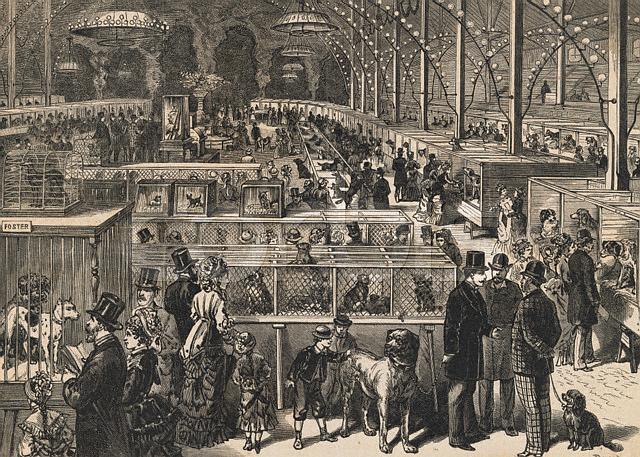
1877 dog show


In 1883, John Russell died at the age of 88. After his funeral, the few remaining dogs he had with him at Black Torrington (four very old terriers by the name of "Rags", "Sly", "Fuss" and "Tinker") were given away.

On the day of his funeral, his old sermons and other papers were found blowing around in the farm yard. Little or no self-authored record of Reverend John Russell survives to the present day.

In 1893, Rawdon Lee, Kennel Editor of "The Field" magazine, published Modern Dogs and noted the absence of Devon terriers on the show ring bench:


"There appears a semblance of strangeness that the wire-haired terriers from Devonshire have not been more used for show bench purposes, and by all accounts some of them were as good in looks as they had on many occasions proved in deeds. Those owned by the Rev. John Russell acquired a world-wide reputation, yet we look in vain for many remnants of the strain in the Stud Books, and the county of broad acres [the north] has once again distanced the southern one in the race for money. But, although the generous clerical sportsman occasionally consented to judge terriers at some of the local shows in the West, he was not much of a believer in such exhibitions. So far as dogs, and horses too, were concerned, with him it was 'handsome is that handsome does,' and so long as it did its work properly, one short leg and three long ones was no eye-sore in any terrier by the late Rev. John Russell."

Lee went on to note that the best working dogs, even in his day, were not found in the Kennel Club:


"As a matter of fact, those [terriers] best adapted for hard work either with foxhounds or otterhounds are cross-bred, hardy dogs, specially trained for the purpose, although many of the 'pedigree' animals will do similar duty to the best of their ability, but their 'pedigree' and no doubt inbreeding to a certain extent, has made them constitutionally and generally weaker than their less blue-blooded cousins."

Finally, to put a cap on it, Lee wrote:


"I have known a man act as a judge of fox terriers who had never bred one in his life, had never seen a fox in front of hounds, had never seen a terrier go to ground ... had not even seen a terrier chase a rabbit."

Only 20 years had passed since the founding of The Kennel Club, but already the death knell was being sounded for the fox terrier.

How was this possible? The short answer is that at the time Rawdon Lee was writing, The Kennel Club was undergoing a "terrier craze."

Why was this? One can only guess, but I would venture to say that terriers then, as now, fit both practical and psychological needs.

On the practical side, they are small, easy-to-keep dogs. On the psychological side, they are active dogs and not too "girly" for a man or active woman to own.

Fox terriers, in particular, have a pretension to field sports about them, and they particularly appealed to those that sought to associate themselves with the money, romance and aristocracy of the mounted hunts.

In fact, the first breed-specific publication was the Fox Terrier Chronicle, which tracked the comings and goings of Kennel Club shows as if they were High Society.

Special dog shows were started just to showcase terriers, and in 1886, a dog food salesman by the name of Charles Cruft took over the Allied Terrier Club Show at the Royal Aquarium at Westminster, with an eye towards making it a cash venture. This terrier show became the first formal Cruft's Show" when it was booked into the Royal Agricultural Hall, Islington in 1891.

In 1884, the American Kennel Club was started, and the terrier craze that had begun in the U.K. swept into the United States as well. Some small indication of this strength of this craze suggested by looking at the history of the Westminster Dog Show which awarded its first "best in show" award in 1907. The first winner was a fox terrier. A fox terrier won again in 1908, 1909, 1910, 1911, 1915, 1916, and 1917.

It was into this terrier-besotted world that Arthur Heinemann stepped -- a young man with an interest in badger digging. Heinemann was born in 1871, the year that John Russell gave up his hounds for the last time, and he was only 12 year old when the Reverend John Russell died.

Heinemann became interested in badger digging when he was in his 20s, and in 1894, he create the Devon and Somerset Badger Digging Club -- a small regional club composed of similar like-minded friends.

Where did Heinemann get his dogs? Not from John Russell.

As noted earlier, Russell gave up hunting the year Heinemann was born, and he died when Heinemann was only 12 years old. Heinemann and Russell never met.

Getting a working terrier was not much of a problem in any case. As noted earlier, white-bodied fox-working dogs were far from uncommon even in Russell's youth, and by the 1880s they were a fixture in the Kennel Club and cross-bred types were to be found all over the countryside.

As noted earlier, Russell himself did not keep a pure line of dogs, and was a bit of a dog dealer himself. By the time of Russell's death, almost anyone could have said they owned a dog descended from Russell's stock. Since Russell did not register his own dogs, and no pedigree charts survived his death (if they existed at all), who was to say otherwise? Anyone that wanted to make a claim that they had dogs descended from John Russell was free to do so -- and a few did so.

One of those people was Annie Rawl Harris, who was Kennelmaid to Squire Nicholas Snow of Oare and a relative of Will Rawl, John Russell's kennel man.

Did Annie Harris have direct descendants of John Russell's dogs? Of course. Who didn't?

As Dan Russell (the pen name of Exmoor hunt terrierman Gerald Jones) once observed in an interview with Eddie Chapman,


"John Russell was very much a dog dealer, as well as a breeder. He would buy or scrounge any terrier he thought looked like work, make it and sell it on. He always went each year to Scorrier House in Cornwall for a stay. They had their own strain of Fox Terrier there called the Scorrier terrier, which was reputed to be bred pure for over 200 years, and on leaving he would take on any terriers they didn't want."

And so we come to it: Not only were John Russell's type of dogs not unique to the Parson, he was not shy about selling them off and buying more terrier stock to breed back in. Any small white-bodied dog in the West Country could claim (perhaps legitimately) that it was descended from John Russell's own dogs.

Perhaps here is a good time to point out that Arthur Heinemann's terrier club was called the Devon and Somerset Badger Digging Club. His hound pack (acquired in 1902) was the Cheriton Otterhounds.

Badger. Otter.

The point here is that Heinemann was not chasing fox -- he was digging badger with terriers, and chasing otters with hounds and terriers. This is a point glossed over by some, but it is not insignificant, as chest size is far less of a concern when working badger and otter, than it is with fox.

In any case, in 1914 the Devon and Somerset Badger Digging Club changed its name to "The Parson Russell Terrier Club."

Why the name change? Well, to be blunt, and to use the words of his friend Dan Russell (aka Gerald Jones), Heinemann was a bit of a dog dealer who “sold a hell of a lot of dogs," both in the U.K. and overseas. He and his friend Annie Rawl Harris found that if they branded and sold their dogs as "Jack Russell Terriers" they sold better.

Why did they sell better? Well, to put it simply, no one wanted a Kennel Club Fox Terrier!

As Rawdon Lee had observed, the best working terriers were not Kennel Club dogs -- they were cross-bred dogs or dogs that were found far outside of the show ring. While the Reverend John Russell had called his own dogs fox terriers, and Rawdon Lee was still calling them fox terriers 10 years after Russell's death, by the turn of the Twentieth Century, a new name for working dogs was needed.

And that name was NOT the "Parson Russell" Terrier." It was the "Jack Russell" terrier. That was what Robert Leighton called them in his 1910 book, Dogs and All About Them, and it was the term increasingly being used in the working terrier community as well.

For evidence of this we need only turn to Jocelyn Lucas's Hunt and Working Terriers, written between 1927 and 1930, and published in 1931.

At the back of this book, Lucas lists more than 100 mounted hunts in the U.K. and details the types of terriers they themselves say they used in the field.

This was a period when the name of the dog was in transition. I say transition, because the word "fox terrier" is used in the list about as much as "Jack Russell," and other phrases appear as well, such as "white hunt terriers" and "Devonshire working terrier." In a listing of over 100 mounted hunts, however, not one claims to be working a "Parson Russell Terrier," and most of the time the word "fox terrier" is carefully proceeded by the words "cross," "cross bred," "non-pedigree," or even "mongrel."

In short, whatever a working terrier was been called in Heinemann's era, it was never called a "Parson Russell Terrier." The confusion arises, perhaps because Heinemann's badger digging Club was renamed, in 1912, the Parson Russell Terrier Badger Digging Club. The dog, however, was always called a Jack Russell Terrier. A club is not a dog.

Arthur Heinemann died in 1930 from pneumonia after coursing his lurchers in the rain (and falling through the ice on a pond), but Annie Rawl Harris continued selling Jack Russells and maintained the Parson Russell Terrier Club until it dissolved just before the Second World War.

Again, to quote Dan Russell from his own book Jack Russell and His Terriers:


"[Mrs. Harris] very quickly took the place of Heinemann as the arbiter of the Russell type terriers and she carried on breeding the type of terrier Heinemann had loved. In her heyday, she had some 50 puppies out to walk each year. She sent her stock all over the world. Her method of breeding was to use only dogs and bitches of proven gameness."

After War World War II, England seemed to get along perfectly fine without a Parson Russell Terrier Club. In fact, the 1950s, 60s and 70s were the Golden Age of terrier work in the U.K., as the weekend was invented (a product of the union movement), and it was now easier to get out to the countryside than ever before.


Add into the equation was the rise of distemper vaccines which prevented massive kennel loss, and the advent of antibiotics which helped prevent occassional gashes and wounds from getting infected, and it was truly the best of times.

Though myxomatosis arrived in the 1950s and devastated many ancient rabbit warrens throughout the U.K, the decline in rabbit populations was offset somewhat by a ban on the use of leghold traps (gins).

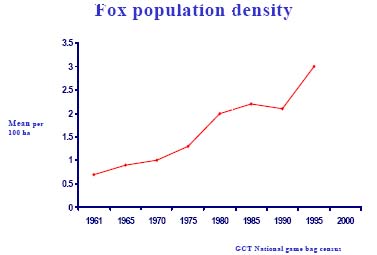
All through the 60s, 70s, and 80s, the fox population rose (see graph at left), and with it the chance of finding a bit of sport with the terriers in the countryside.

In 1974, the Jack Russell Terrier Club of Great Britain was founded "to promote and preserve the working terrier known as the Jack Russell".

In 1976, its U.S. analog was created -- the Jack Russell Terrier Club of America (JRTCA).

Both clubs have prospered and stuck to their original mission, and today the Jack Russell Terrier Club of America remains the largest Jack Russell terrier clubs in the world.

With an increase in the popularity of the Jack Russell terrier in Great Britain and the U.S., a push was initiated in 1983 to pull the Jack Russell into The Kennel Club. In 1990 this was finally done with representatives from several smaller Jack Russell Clubs meeting to draw up a conformation "standard" that called for a dog standing 12-15 inches at the withers.

It is claimed that this Kennel Club Standard was adopted from one originally written by Arthur Heinemann, but no evidence to support this claim has ever been presented so far as I know.

Dan Russell, who hunted with Heinemann and knew him well, says Heinemann did not value a large dog.


"As I remember it, and I am going back now sixty years or more, his main Badger dogs were about 12". He always said there was nothing a good fourteen inch terrier could do that a good eleven inch terrier couldn't do better. But it must be remembered he was referring to Badger digging in his own part of the West Country. His smaller terriers could manuever so much better in the large drawn out pipes of a badger set, they depended on their voice to keep the badger cornered for the diggers to hear, not brute force as some people seem to think. They were clever, game baying terriers, nothing more. Some of his best workers were no more than ten inches."

In his own book, "Jack Russell and His Terriers," written in 1979, before The Kennel Club controversty, Dan Russell quotes Heinemann directly:


"We are very much opposed to the modern show terrier and his type. Once you begin to breed it for show type, you lose the working qualities upon which you pride those terriers. I have been, I might say, the protagonist of the terrier bred for sport as against the terrier bred for show. I have no interest in cup hunting."

What Reverand John Russell or Arthur Heinemann wanted for the dogs, or what they actually used in the field, however, mattered not a whit to the Kennel Club.

In 1990 the Kennel Club admitted on to its roles a dog they called the "Parson Jack Russell Terrier," a name just invented for the occassion. In 1999 The Kennel Club changed the name to the "Parson Russell Terrier," another name invented wholecloth by Kennel Club theorists.

The American Kennel Club followed the U.K. Kennel Club in embracing both the 12-15 inch standard and in embracing the various inventeed names and name changes.

In 2005, The Kennel Club added a bit more confusion to the story by changing the standard for the dog they were now calling the Parson Russell Terrier, extending it to encompass dogs ranging from 10 to 15 inches tall at the shoulders.

The American Kennel Club has not followed the U.K Kennel Club in changing the standard, instead chosing to simply create another breed of dog (now in its Foundation Stock Service) called the "Russell Terrier."

The breed description of this dog claims it "originated" in the United Kingdom, but that it was "developed" in Australia -- a country which John Russell never so much as visited, which had no Jack Russells at all until the very late 1960s, and where the dog in question remains a pet and show dog that never sees a moment's work. The AKC "Russell terrier" standard calls for a dog standing 10-12 inches tall at the shoulder.

How to sort it all out then?

I think simplicity is best. In my opinion, there are only two types of terriers in the world: those that work, and those that don't. The white ones that work are called Jack Russell Terriers, and they are called that out of respect for the working standard that the Reverend John Russell himself honored throughout his life. Many of these white-bodied working terriers are not registered, but neither were any of the Reverend's own dogs.

What are we to make of the Kennel Club dogs? Simple: They are not Jack Russell terriers.

They are not Jack Russells in name, nor are they Jack Russell terriers in terms of performing regular honest work.

They are simply another white terrier being combed out, powdered, and fussed over by Kennel Club matrons.

So is there any place where the Parson Russell theorists and the practical working Jack Russell people might find common ground?

Oddly enough there is, though it is an area generally overlooked by the show ring crowd, and one they will no doubt surpress as time goes by.

The issue is chest size.

Barry Jones, a professional terrierman to the Cotswold Foxhounds in Andovers Ford, and a former Chairman and President of the Fell and Moorland Working Terrier Club, and the founding Chairman of the National Working Terrier Federation, was also a founding member of the Parson Russell Terrier Club. He warned the club to keep its eye on chest size, noting that:


"The chest is, without doubt, the determining factor as to whether a terrier may follow its intended quarry underground. Too large and he/she is of little use for underground work, for no matter how determined the terrier may be, this physical setback will not be overcome in the nearly-tight situations it will encounter in working foxes. It may be thought the fox is a large animal - to the casual observer it would appear so. However, the bone structure of the fox is finer than that of a terrier, plus it has a loose-fitting, profuse pelt which lends itself to flexibility.

I have not encountered a fox which could not be spanned at 14 inches circumference - this within a weight range of 10 lbs to 24 lbs, on average 300 foxes spanned a year. You may not wish to work your terrier. However, there is a Standard to be attained, and spannability is a must in the Parson Russell Terrier. "

Eddie Chapman, a working Devon hunt terrierman for more than 30 years, agrees that 14 inches is the maximum chest size for a fox. In The Working Jack Russell Terrier, he writes:


"I am a small man and have reasonably small hands, but in more than 20 years in which I have handled well over 1000 foxes, I have never handled a full grown fox which came anywhere near the span of my hands. The biggest I can remember was a South Hereford fox that was one and a half inches smaller than my hand span, and that without my squeezing him. It therefore follows that if I can pick up a dog and just span him with a squeeze, then the dog cannot get to the fox in a tight place and a dog that cannot get to a fox cannot be considered a Jack Russell. Either you are breeding a terrier suitable to work fox or, if he is too big to get to a fox, you are just breeding for looks. This is, of course, what happened to the pedigree Fox Terrier and look where that has got him!"

What is the future of the Jack Russell Terrier? The same as it has always been: as a working terrier in the hands of owners that will actually take it out to work it. Such people have always been rare. They were rare in John Russell's day, they were rare in Arthur Heinemann's day, and they are just as rare today.

As for the "Parson Russell" terrier and the "Russell" terrier they are completely interchangeable with every other terrier on the Kennel Club's roles. These dogs have no claim to history, and they have no future as honest workers. They stand as a complete rejection of every value ever held by John Russell and Arthur Heinemann, both of whom rejected Kennel Club registration and valued their own dogs based on performance in the field rather than Kennel Club points in the ring.

The good news is that with the name changes, no one will now confuse these Kennel Club dogs with the real Jack Russell Terrier.
.
_____________

Footnotes:


  • It should be said that Dan Russell (i.e. Gerald Jones) was himself terrierman for the Exmoor, Enfield Chace, and Old Berks hunts, and knew more than a bit about what was needed in a working dog.
  • Annie Rawl Harris was, for a time, housekeeper for Henry Williamson who wrote the book "Tarka the Otter."
  • The Scorrier terrier is associated with the Williams family and the Four Burrow Hunt.
  • The quotes in this piece come from the various books cited (and often pictured). For those that want a visual presentation of the history of working terriers, see A Pictorial History of Terriers; Their Politics & Their Place on the www.terrierman.com web site.
    .