Wednesday, April 30, 2014

Scent Work 101


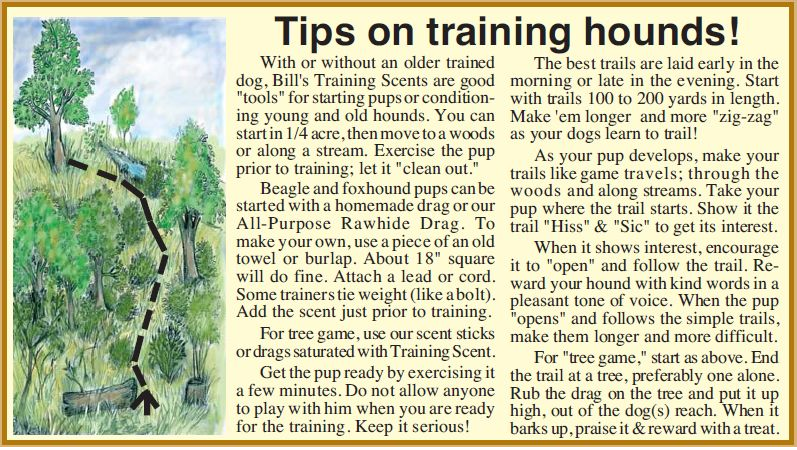
Working terriers operate as diminutive scent hounds.

In fact, the work of a terrier is indistinguishable in the field from that of a dachshund (a true scent hound).

Both dogs find their quarry by sniffing the air and the ground until they happen to cut across a "hot" trail leading to a hot hole.

Most folks who work terriers find they do not have to do too much to actually get their dogs operational.

The same is true for most scent hound hunters. Scent is a powerful stimulus for dogs, and they will naturally follow a "sweet" scent out of curiosity, or some small hope of food, sex, or excitement.

So how do you amplify and channel this natural trait?

For starters, get a bottle of fox, raccoon or coyote pee from a local hunting or sports store or from a mail-order vendor like Amazon.

Next you need to make a drag out of an 18" inch square piece of heavy cloth or leather chamois (available at any auto-supply store).

Tie a 15-foot piece of cord to your scent drag, and slide a small stack of metal washers or fishing weights down the cord so the drag now has a small amount of weight attached to it.

Now load some of your store-bought critter pee into a cheap spray bottle, being sure not to get any on your hands.

Finally, obtain a package of hot dogs.

Got it all?

Good. Now we are almost ready to go train the dog!

Before we do that, however we want to get your dog well-motivated, and the secret here is to not feed the dog for a full 24 hours. You want that dog sharp! A hungry dog is a brilliant dog.


Now load everything into your truck or car and go out to a farm area where a grassy field or meadows borders a forest.

Leave your dog crated up in the car or truck while you walk down the edge. You should have the leather drag with you, along with the hot dogs, and the spray bottle with the critter pee in it.

About 200 feet from the vehicle, stop and spray the leather drag with critter pee, coating it well, but not getting any on yourself.

Now drop the drag in the middle of the trail (you can spritz the trail itself if you want) and walk perpendicular to the edge habitat, heading up into the grassy field.

As much as possible, you want to make an obvious trail in the grass, dragging the pee-scented leather or cloth behind you.

At the end of a straight 30-foot drag, stop and leave half a hot dog right in the middle, where it is quite clearly visible.

Pick up the drag and walk back the way you came to the exact spot where you took off perpendicular to the path.

From this spot, continue down the edge another 50 feet and then drop the drag and cut across the trail again, this time going 40 feet going into the woods side, dragging the pee-scented leather or cloth behind you as before.

Scuff logs and break a little brush as you go. An easily visible trail with a lot of scent is not a bad thing to have early on in the training process.


At the end of this straight 40-foot drag, leave the other half of the hot dog in plain site.

Continue down this math, making scent trails this until you have run out of hot dogs, each time making the distance to the hot dog a little longer, curving the trail, and perhaps making the trail a little less obvious.

Now take the dog out on a leash and walk down the path you started. You can slow down a little at the spot where the first "trail" goes off into the grass. Give the dog a chance to succeed, but do not shove the dog or make suggestions. Be calm and mellow. The scent is supposed to do the work, not you.

Once the dog starts down the path (you will wait at this spot until it does), quietly encourage the dog. When the hot dog has been found, and after it has been gobbled up, make a big happy production out of it with a little play and a scratch behind the ears. Good dog!

Now let's see if we can do that again another 150 feet down the hedge.

Repeat this process a dozen times an outing over the next few weeks, extending the trail, curving the trail and even cutting off at sharp angles.

In only a few outings, your dog will quickly "get it." The smell of a critter means hot dogs and play! Critter smells are FUN to follow.

Next, start putting live rats or mice in rat boxes at the end of the scent trail.  As much as a dog likes a bit of hot dog, they will like this part more, as once the rat box is located, the mouse or rat is going to be released for the dog to chase.  Will he catch it?  Maybe, maybe not.  Either way, the code will explode inside the dog provided it is over 6 months old, and pretty soon you will have a dog that is truly scent hunting and looking for vermin with a vengeance.

The NRA Wants You to Eat Lies and Poop Fear


Look around you. 

Kids are going to school, people making coffee, going off to work, mowing their lawns.

People are happy and honest, helpful and law abiding.

IGNORE THAT REALITY. Please substitute that reality for this video.

Eat up the lies and poop out the fear and paranoia.

Because the best America is one in which we are all angry porcupines, quills out, and terrified.

But to for this happen, you must IGNORE the REALITY of your life and substitute your actual day to day experience with this video.

This ad tell us that "It takes a special kind of courage to reject the world that is around you."

Right.

Free Dumb.

Oh, and that "5 million member" line at the end? Complete bullshit.

The real membership of the NRA is less than half this.  We know because the NRA mails their magazine to every member, and their circulation is audited by the Alliance for Audited Media. And guess what?  A lot of those 1 million "life members" that the NRA claims that are actually dead.  Or, as former NRA board member David Gross has noted, "There just isn't that much incentive to go find out when someone passes away, not when the cost of maintaining (a dead member) is minimal and when they add to your membership list."

Right. Liar, liar, pants on fire.

NRA membership is rarely presented against any kind of scale, so let me do that.

AARP mails their publication to over 22 million people.

Game Informer (a video game magazine) mails to 7.8 million people.

Prevention magazine mails to 2.8 million people.

In a country in which 14.6 million people hunt, more than 83 percent of those people are NOT NRA members, and many NRA members are not hunters at all, but testosterone-depleted Walter Mitty types.


But set that aside.

Consider the fact that in their introductory video, one of the first things the NRA does is lie to us about itself.

NRA and PETA and HSUS are all one and the same -- direct mail liars for hire. Kick them all to the curb.

Free Dumb


A baby seat for your Harley. And no helmets. From Look magazine, 1962, via Shorpy.

Ducks Go Mammal

Low Cost and Solid Rat Boxes


If you are training a young terrier to trail and enter, and have no adult dog to demonstrate the ropes, one of the things you will want is a container for rats, mice, or squirrels.

I have made all kinds of critter boxes and wire cages in the past, but a very low-cost and simple solution can be found in the plumbing and home drain section of your big box hardware store. 

Plastic pipe elbow joints fitted with drain grates are ideal for rats and mice (you will need a bigger section for squirrel) and are ready made. Yes, a rat can gnaw out of these if left in there permanently, but as a very temporary pot for field training and go-to-ground work, these do well.

Tuesday, April 29, 2014

Brothers from Different Mothers


You know what's nice?

What's nice is that these two found each other.

Perfect!

How to Strip a Terrier

Trooper, the old man, then in retiremen and now dead.

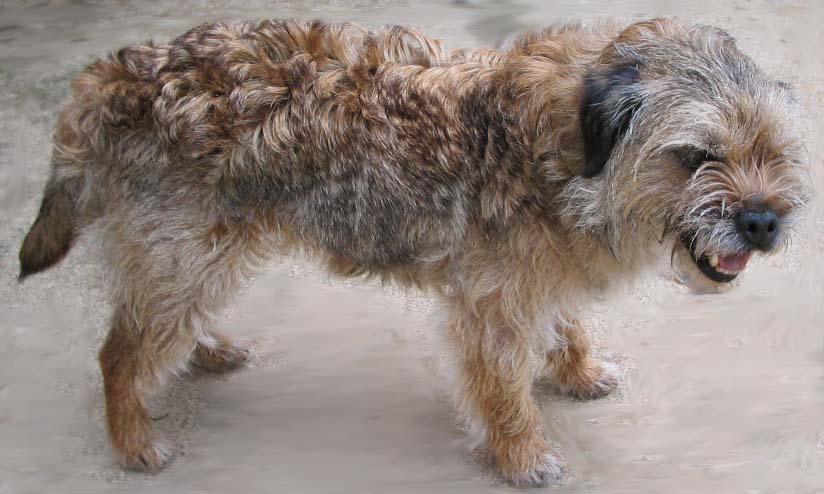
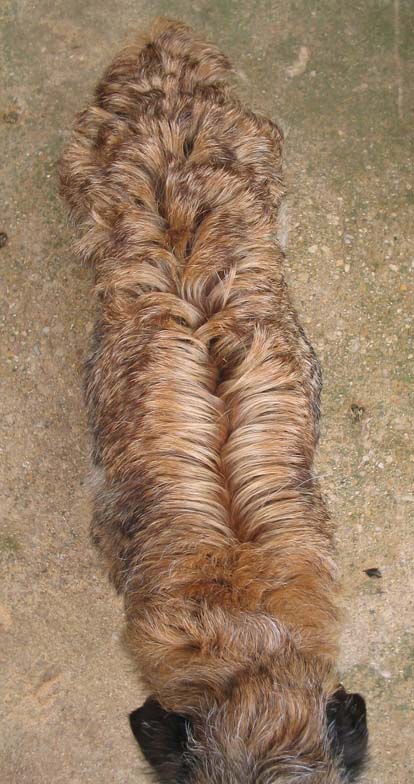
The trick to stripping a terrier's coat is to to wait until the dog's coat has blown and is really ready to come out. One good indication that this has happened with a Border Terrier is that the hair at the shoulders will naturally "part" as can be see in the picture below.


You will need only two tools to strip a terrier.  Most of the job will be done without a tool at all -- you simply use your fingers, grasping small bits of hair and pulling "with the grain." 

The hair should come out fairly freely, with a light to medium-strength tug.  Work slowly, plucking a little at a time, and scratching the dog behind the ears as you do so, and perhaps taking a little break to play ball.

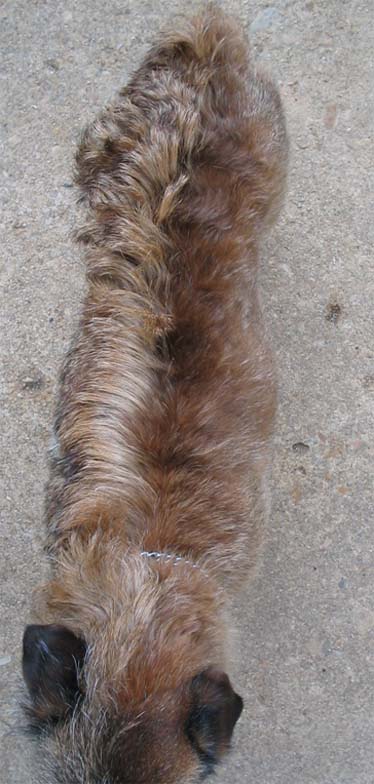
The picture below shows the dog half stripped, with the left side left long, and the right side getting down to the reddish undercoat on this dog.


Somewhere along the line on this half coat, I would have switched from pure fingers to a stripping knife.

A stripping knife is really just a saw-toothed tool that looks a bit like a butter knife with serrated teeth, or else a very stiff hacksaw blade. The tool is made to help make it easier to grasp hair, and the teeth are designed to do a little light cutting as they pull. Most stripping knives are too sharp from the factory and need to be dulled with a rope. A lot of different kinds of stripping knives are sold, but I get the medium, and generally the cheapest, and I am done with it. I have used Mars and McClellan's in the past and they have worked fine. I have never used any of the new and weird things developed for pet owners -- dematting tools, miracle combs, or looped curry combs of the kind frequently sold in pet stores. Stripping knives are the tool to use, and they are almost never found in a pet store as pet terriers generally do not need them, as most are scissored.


If you are new to stripping terriers, be very careful using a stripping knife. It is very easy to "pull a hole" in a coat and it will take a long time for the coat to fill back in once that is done. It's far better to begin by pulling 85% of the coat with nothing by your fingers. If the coat is really ready, fairly large chunks of hair will come out pretty easily. Go slow and let the dog rest between sessions if it looks like it is getting irritated. There is no reason to do it all in one day, especially if this is your first time, your hands are not too strong, or the dog is not very cooperative.

After stripping down the coat, I generally scissor the vertical ruff at the back edge of the legs and trim any rough lines a bit with scissors, including around the pads, the back vent, and underneath near the privates.  I am talking about very little snipping here.  Terriers are to be stripped, not clipped, unless you want a soft coat. 

If you scissor a terrier coat it will get soft and stay soft.  Some people prefer that, and it's generally done that way for older dogs in retirement, but a working dog is stripped. Having said that, a working dog is NOT stripped down to its underwear all-year-long as is done in the show ring to hide improper soft coats.
.
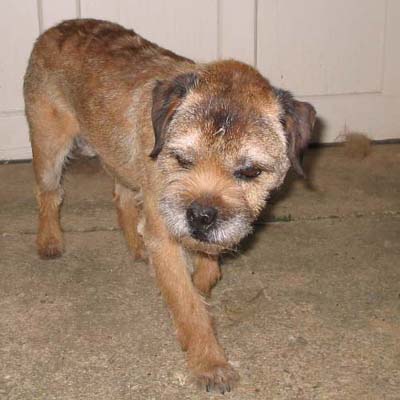
The more-or-less finished product.
I do not strip my current dogs, and I find most working terriermen do not do too much stripping either -- they are either getting smooth-coated or lightly-broken coated dogs, or else their dogs have sufficiently harsh coats that they are "self-stripping" in the sense that the harsh hairs grow brittle and snap off on their own.

What is the purpose of stripping? 

Good question! 

For my Borders, who worked in the summer, it was a way of keeping them cooler. That said, a true digging dog is bathed rather frequently and combed out pretty often too.  Theorists will tell you this is not true, but theorists never wash mud, dirt and blood off a dog on a regular basis, never treated a bite wound, and have never combed out a billion seed ticks hiding in a coat. A true working dog (and by a true worker I am not talking about a three-holes a year dog) is getting a lot of practical coat care from a human, and it is also seeing a lot of wear underground against rock and root, to say nothing of above ground with briars and brush.  So yes, working terriers are stripped, but generally this stripping is done on a rolling basis as a part of their working life.  A stripping knife may never be seen (or seen rather infrequently) because the dog has a stripping life and so a stripping knife is not much needed.
.

Solitary


The local rescue Barred Owl.
A boring life for this fellow, but he does get shelter, a fair number of visitors, and all the food he can eat, and he can see the woods all around him. 

Spring Has Sprung

Mandrake or May Apples

Jimmy Stewart on a Man and His Dog

Monday, April 28, 2014

Scottish Island Porn


For the rather modest price of £1.95 million ($3.28 million dollars U.S.) you can buy 766-acre Tanera Mor island in the Inner Hebrides of north western Scotland.  The island can be reached by boat from either Achiltibuie in Wester Ross, or Ullapool.


The one-mile long island has nine cottages, several good piers, a quiet bay, a cafe, no shops, no roads, and a population of just three.


Over the past 15 years, the current owners have planted more than 164,000 native trees as part of a woodland regeneration scheme.


The island has a salmon fish farm, as well as a small sailing school and a post office which has printed its own stamps since 1970.

Cruel Season


The baby bird, the fox kit, and the fawn are likely to be dead within three months of being born -- such is the natural mortality of most wildlife.

Tennyson noted that "nature is red in tooth and claw," but in truth he was an optimist. A great deal of wildlife never lives long enough to see a predator.

More often than not young wildlife simply dies alone, sick and shattered in the hedge, tree den or burrow, the victim of starvation or vehicle impact, disease or parasite, poor parenting, or exposure to the elements.

Rudyard Kipling got it about right when& he noted that in the modern world the most common Blood Sport is not the ancient art of the chase, but haphazard driving by people almost totally unaware of what they have done. As he notes in that great poem, "The Fox Meditates":
When men grew shy of hunting stag, 
The Car put up an average bag
of twenty dead per diem.
Then every road was made a rink
for coroners to sit on
And so began, in skid and stink,
the real blood-sport of Britain!
.

Five Ways The UKC is Exactly like the AKC

AKC and UKC:  Distinct registries without much of a difference.

  1. The UKC registers puppy mill dogs and in fact this has been a core part of their business for the last 50 years. 

  2. The UKC registers over 300 breeds of dogs (more than the AKC), including the same deformed, diseased, and dysfunctional breeds as the AKC, such as the English Bulldog, Cavalier King Charles Spaniel, Pug, and Pekingese.

  3. The UKC requires no health checks or health testing to register or breed a dog.  

  4. The UKC does not ban incest or require a low coefficient of inbreeding. The UKC operates as a closed registry, and with half as many dogs spread over a larger number of breeds, the effective population size in most breeds is very small.

  5. The UKC registers entire litters at birth, which means registration occurs before the most obvious health problems can be assessed.

In a recent HBO segment, we are told Wayne Cavanaugh walked away from being Vice President of the American Kennel Club because that club was "rewarding unhealthy ideals" and that he was "made president of the United Kennel Club" after that.

Sounds great, but simply not true

Wayne Cavanaugh left the AKC in August of 1999 because the long-time owner of the United Kennel Club, Fred T. Miller, was sick and looking to hand it over to someone who would buy it.

Cavagaugh saw this for what it was -- a rare chance to take over a large canine registry and make money.

Fred Miller died in March of 2000, six months after Cavanaugh came on as General Manager of the UKC, and his widow, Connie G. Miller, sold the UKC to Cavaugh in November of 2000 for an undisclosed sum. Prior to Miller buying the UKC in 1973, the United Kennel Club had been closely held by the family of Chauncey Bennett who founded the UKC in 1898.

In the 14 years that Wayne Cavanaugh has owned the United Kennel Club, the registry has not "reformed" itself in any meaningful way.

In fact, every major registration criticism leveled at the American Kennel Club is equally true of the United Kennel Club to this day.

Puppy mill registrations? Check. 


Incest OK?  Check.

No required health checks or tests? Check.

There is, of course, one important difference. 


While the AKC has a large Byzantine bureacray to slow down institutional change, Wayne Cavanaugh could transform the UKC overnight with the stroke of a pen.

The fact that he has not done so makes his touting of himself as a reformer the most naked kind of misrepresentation.

Is his heart in the right place?  Let me say that I am sure that it is.

That said, Diogenes the Cynic advised to ignore the words of men and look to see what they do.  Diogenes, of course, was a TRUE dog man.


And so, if we look at what Wayne Cavanaugh has done it is very little.  There has been a lot of talk, but talk is cheap. 

Mr. Cavanaugh's United Kennel Club continues to stand with arms wide open for the puppy millers and their Pekingese, Cavalier King Charles Spaniels, Chinese Cresteds, Boston Terriers, Pugs, and English Bulldogs. 

An inbred litter? No problem! 

A dog born Cesarean? Fine! 

Puppies from a "high volume breeder"?  How would we know, and wouldn't it be wrong to discriminate?

Register only adult dogs that have passed a veterinary inspection? No can do.  

So far, the UKC has been given a pass because it is half the size of the American Kennel Club.

Maybe it's time for that pass to be revoked.


Sunday, April 27, 2014

Ancient Thorn Hooks Still Work

Clicker Training With Landmines


There's clicker training, and then there's "Landmine-detection rats: An evaluation of reinforcement procedures under simulated operational conditions."

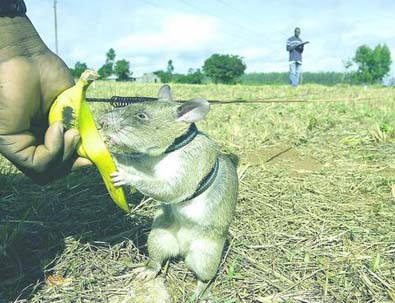
I have written before about landmine detection using Gambian Pouch Rats, so this is is not new. That said, normally it's "click and treat" not "click and go boom"!

Shoot a Poacher, Save a Wolf


Idaho conservation officials say poachers almost certainly kill more wildlife in the state than wolves do.

Yet, poachers continue to get the big wink from state legislators, with anti-poaching law enforcement put on a starvation budget, and relatively low fines levied on those few who are caught.

Fish and Game officer Barry Cummings, notes that if wolves killed as many deer, elk and other wildlife as poachers did, Idaho citizens would be howling and manning the ramparts:

We would be setting budgets aside. We would develop a group... and we would develop a plan to deal with it. But we won’t even talk about what impact (poaching) has on wildlife.

A few numbers:  Idaho covers 84,000 square miles, but has only 104 Fish and Game officers, which means every conservation officer in the state is responsible for patrolling nearly 1,100 square miles.

Clearly, that's an impossible task and not really happening.

So what could happen?

Well, for one thing, Idaho could do a much better job of rewarding folks who turn in poachers. While Idaho has a web form you can fill out, and a phone number you can call, there is no reward mentioned.

Since shooting animals out of season and without license is fully incentivized (Catch me if you can!) and integrity is NOT incentivized (a $100 award might be offered a tipster) guess which one the state gets more of?

Irish Dog Shows of the Past, 1928, 1921


Saturday, April 26, 2014

HSUS By the (Falling) Numbers

NOT ACTUAL SIZE

As I noted some time back, the Humane Society of the U.S. habitually misreports (we used to call this lying, but let's be nice) about the size of their membership.

While HSUS once claimed 11 million members, its true membership was less than 450,000.

As I noted, it's important to not to be shocked by petty puffery when organizations cite inflated membership numbers.  But was this petty puffery?
Now to be clear, a lot of organizations lie about their membership numbers. The most common gambit is to assume that every dues-paying member also represents a spouse or an adult child who might also support the core mission of the organization.

Fair enough, I suppose.

But what HSUS has done is truly unprecedented. You see, they have not inflated their true dues-paying membership number by a factor of two or three.... but by more than 24.

Divide by twenty-four.

That's what the board of HSUS and all their supporters should do.

Divide by twenty-four.

Take the salary of Wayne Pacelle -- more than $240,000 a year -- and divide by 24 to see if that "mathematical adjustment" might clarify the extent of the lie that HSUS continues to perpetrate on the American people.

Divide by twenty-four.
All of this is preview to the fact that I have a letter out to Alan Heyman, Vice President for Communications at the Humane Society of the U.S.

When asked about their finances by the Associated Press at a Hollywood gala fetting actor James Cromwell, Mr. Heyman said, the organization's "finances are an open book."

Which would be terrific if true, as I have a few questions.

I fired off an email to Mr. Heyman a month ago with questions about the numbers underlying their direct mail program (no proprietary information was asked for, I assure you!), and I sent him a tickler about that email last night.

Let's see if he responds.

For those who want to urge him to respond, this is his email.

If you send him a note, be sure to be really nice. I am sure he is a wonderful fellow who is very busy and that he is desperate to set the record straight about the direct mail economics of the Humane Society of the U.S.

And to honest, the Humane Society of the U.S. should be desperate to set the record straight: their direct mail program is facing Racketeer Influenced and Corrupt Organizations Act charges, and their latest Annual Report shows that contributions to HSUS have fallen $20 million over the course of the last year.  

Ouch!

But to be fair, a $20 million drop in revenue is not that much.  

You see HSUS took in $267 million last year.  

And what did they do with all that money?  A lot less than they claimed

Like the RSPCA in the U.K. the Humane Society puts in BIG NUMBERS their claims of direct animal assistance, but puts in    little type   the fact that this assistance was almost entirely done by their "affiliates" to whom they give almost ZERO financial support.

That said, HSUS seems to have reigned in their membership numbers. Did I help do that? I would like to think so, but I suspect that that RICO litigation might have helped a great deal more.  

In any case, HSUS now claims 1.1 million "readers" of ALL HSUS publications combined, which means they are now engaged in conventional puffery (i.e. it's a safe bet you can divide that claimed "readership" by average family size of 2.48 persons per household).

All good and carry on.  Now about those direct mail numbers... 
.

Friday, April 25, 2014

The Coton de Tulear: When AKC's Newest Breed of Toy Dog Hunted Wild Boar in Darkest Africa


Today's Associated Press article announces the latest AKC joke:

'Royal Dog of Madagascar' to Join Westminster Pack

Notice the quote marks in the headline.

No one is saluting this nonsense. It's more of the wink-wink, nudge-nudge that we get in the world of dogs, where pathological liars pocket big bucks selling bunko to the gullible, the stupid, and the uninformed.

The 'Royal Dog of Madagascar', of course, is the Coton de Tulear, which is a breed invented in the late 1960s, at about the same time that the Bichon was being trotted out as distinct from the Maltese.

I have appended below the breed history of the "Coton de Tulear," lifted straight from Wikipedia.

Note that this breed history here follows the basic structure of most nonsense canine histories:
  1. A specific location of creation, preferably exotic (Madagascar!);

  2. An ancient "possible" provenance (somewhere back there in a 200-year span of time);

  3. A big dollop of romance (Pirates!)

  4. A weak claim for work (any dog can rat and rabbit);

  5. A very recent date of Kennel Club registration (early-1970s);

  6. A named person or two who "discovered" the dog (and who put together all of this nonsense "history");

  7. A bit of ancillary garbage to give the illusion of granular detail;

  8. A putative claim that the dog is descended from some other dog lost in the mists of time (in this case a "Tenerife Terrier").
The Wikipedia entry for this breed reads (no, I am not making this up):
The Coton de Tulear developed on the island of Madagascar and is still the island's national dog. It is believed that the tenerife dog was brought to Madagascar, and mated with a dog of the island, and created unexpected twist. The Coton's ancestors were possibly brought to Madagascar in the 16th and 17th centuries aboard pirate ships. Madagascar was a haven for pirates, and pirate graveyards can still be seen there. Pirates established a base on St. Mary's Island, Madagascar and some of them took Malagasy wives. Whether the dogs were brought along to control rats on the ships, as companions for long voyages, or were confiscated from other ships as booty no one knows. Tulear is a port now also known as "Toliara". The Coton is of the Bichon dog type, linked most closely to the "Bichon Tenerife", and Tenerife Terrier. There have been many stories circulating about the history of the Coton in recent years. Most of them are untrue. The Coton de Tulear was never feral on Madagascar. It did not hunt wild boar or alligators, as its size, strength, and demeanor can disprove easily. It was a companion dog of the Merina (the ruling tribe) in Madagascar. It has very little prey drive, and is not a hunting dog.

The cottony coat may be the result of a single gene mutation. This small, friendly dog caught the fancy of the Malagasy royalty and they were the only people allowed to keep Cotons. When Dr. Robert Jay Russell discovered the breed in Madagascar in 1973 and brought the first ones to America, he coined the phrase the Royal Dog of Madagascar and the name stuck. They were also imported occasionally into France by returning French colonists but were not officially imported to Europe until the 1970s.

The Coton de Tulear was first formally recognised as a breed by the Societe Centrale Canine (the French national kennel club) in 1970, and was accepted by the Fédération Cynologique Internationale, which published the breed standard in 1972.

Of course, this is the "straight" version.

If you want your nonsense and blarney ladled thick, and with special sauce, head over to "The American Cotton Club" (The Cotton Club, get it??) where they have also added in a shipwreck that has the little dogs swimming through surf to shore!

Right.  Marvelous! Full applause!

The American Cotton Club jumps the moon when they go on to write:
The original Cotons on Madagascar were feral surviving by hunting and scavenging. One of their favorite meals was small wild boar native to Madagascar. They were able to adapt to the natural diverse and rugged conditions on the island. They lived in the rain forests and scrub of southern Madagascar near the sea and the port of Tulear. They had to survive arid conditions on the island as well as the Monsoons. The Cotons led a much different life than their pampered Bichon cousins in Europe. This brought about a strong constitution for survival, a keen intelligence, vigilance, adaptability, alertness. They also learned to live in packs increasing their odds of survival. It is possible the tropical climate of Madagascar influenced the coat developing into a light and airy cotton which was a natural air conditioning.

Wonderful!
  Fantastic. Tell us more!

And, of course, there is more. The dog was adopted by the Merina tribe (was that on Survivor, season two?) and became a pampered dog that could only be owned by royalty. To back this all up, an ancient book is quoted, and never mind if that ancient book (it has not yet been scanned by Google!) describes a completely different dog from the one detailed here.

History!  Fact!  Romance! 

What a marvelous dog! 

Can I put you down for two?  

Why yes, but I would like to get one straight from the island so I know it is the real deal. 

One straight from the island?  Of Madagascar?? Right.  Small problem there.... 

You see due to their huge popularity in France, and the extreme poverty of Madagascar, there are now virtually no "true" Coton's in their homeland of Madagascar!  Any dog you get from there is likely to be a FAKE.  nd there is lots of that going around...

Oh dear!  What a tragedy.

Just imagine going to the Genessee Valley and finding no Genessee Valley Beaver dog, or the Outer Banks and finding no Kill Devil Terrier. This is a tragedy every bit as epic as that!


A "very pretty example of the race" circa 1970.


Of course, the "modern" dog is not exactly the same as that brought to Madagascar by pirates.

It is not exactly the same dog that survived the shipwreck, that swap to shore, that was owned by royalty, and that hunted wild boar in large feral packs.

No, the modern dog has been IMPROVED! 

In fact, it has been improved so many times THAT it looks completely different now. 

Even the "breed standard," written in 1969, has been "improved," first in 1987, and then again in 1995, and then again in 1999. 

And, of course, that's just the European standard. 

There's also an American standard.

So the "standard," as you can see, is as solid as a rock... or at least as solid as a rocking horse.

But no matter. These are dedicated lap dog breeders, and in their world form follows function... like a fish follows a water buffalo.

My favorite breed history of the Coton de Tulear, however, is not written by the French, or the British, or the Americans. It appears on a Dutch site where, according to Google Translator:

As a result of the colonization in the 16th and 17th century, the dodo, a large sort of turkey-like bird that lived on the islands of the Indian Ocean, went extinct.

As a result of that colonization, in its place another brave Dodo species in the Indian Ocean formed in the shape of the Coton de Tulear.

Fantastic! And, of course, absolutely true.

Now, how many of these new AKC dogs can I put you down for?

Descended from packs of wild toy poodles that killed wild boar in Madagascar!
.

Thursday, April 24, 2014

Westminster Announcer Sees What the AKC Has Done to Dogs, And Wants to Change Topics


HBO Sports lifted the title of their segment on the rotten health of many American Kennel Club dogs from this blog, where the term "unnatural selection" has been used in post titles, posters, articles and T-shirts dealing with AKC and Kennel Club selection for defect.

All good.

The goal of this blog has always been to start a conversation and frame the debate, and it's been mildly successful at that mission since before Inbred Thinking (a 2006 post) helped spark Pedigree Dogs Exposed

Of course, the dog health debate is not new, a point I have made before.

Erasmus Darwin was writing about unnatural selection down on the farm long before Charles Darwin was born, and the issue of inbreeding and selection for deformity is very old, and has been self-evident with goldfish, pigeons, and chickens for several hundred years.


In the HBO Sports "Overtime" segment that can be seen above, Bryant Gumbell and Mary Carillo sit down with Soledad O'Brien to discuss the show's segment on dog shows and dog breeding.

The background here is that Mary Carillo has been one of the announcers for the Westminster Kennel Club dog show and the National Dog Show for the last several years, but apparently she had no idea so many AKC dog breeds had serious health issues.

Ms. Carillo says she "assumed" the AKC was about "healthy happy dogs," at which point Soledad O'Brien interjects that she "has heard" that line before. They all laugh at the uncomfortable reality, which is that Mary Carillo is still stumbling through the AKC's public relations script. This is not easy for her. This is going to be hard.

Soledad O'Brian notes that the AKC is not "reluctant" or "slow" to change the breed standards for health purposes -- they simply refuse to do it.

Mary Carillo is clearly uncomfortable. She tries to change the subject to the marvelous diversity of dogs -- part of her Westminster script.

But Soledad O'Brien and Bryant Gumbel come back to it -- the AKC screwed that up too, didn't they?

And then they zero in: Why is the AKC opposed to breed health? Why are those who have concerns about animal welfare now "the enemy"?

Mary Carillo tries to change the subject again to "handbag dogs," but of course that was not what this piece was about, was it? 

Soledad O'Brien brings the topic back to center. The English Bulldog is a top 10 AKC breed, but most of these dogs cannot breathe and most cannot walk in a normal fashion. Soledad says the purpose of this breed was to "bait bulls."  Well, NO, that's not actually true. The English Bulldog has never worked, and is a fantasy dog created long after bull baiting was made illegal in the U.K. The English Bulldog is the wrecked and ruined progeny of crossing a pug with various kinds of deformed and short-legged dwarf molossers in the yard of Bill George over 150 years ago. It's always been a pet dog made for show ring pretenders.  The English Bulldog is not, and never has been, a Pit Bull.

But that is detail.  

The main point is that Mary Carillo clearly has a lot of thinking to do about her relationship with the AKC and the Westminster Dog Show.

Will she mumble along and change the subject while pocketing the cash?

Or will she say, "NO MORE" because DOGS DESERVE BETTER?

Does HBO's Mary Carillo love dogs enough to do that?

Time will tell.


Dog and Cat(fish)

Best Science Sentence This Week

The article in Nature is entitled: Female insect uses spiky penis to take charge. The opening sentence:
In desolate caves throughout Brazil live insects that copulate for days, the female's penetrating erectile organ sticking fast in a reluctant male's genital chamber until he offers a gift of nutritious semen.
If that sentence leaves you confused, see the link.  And if you think we are posting a picture of that, then you would be wrong.  We have.... NOTHING.

Wednesday, April 23, 2014

Why Color is Good on a Jack Russell Terrier

source

Jack Russell Terriers are defined as being more than 51% white.

How much more than 51% white is a matter of preference and genetics.

Color distribution on the coat of Jack Russell terriers is not random.

In fact, the creep of whiteness and the addition of color tends to follow clear patterns. As the good people at doggenetics in the U.K. explain:

Whichever white pattern a dog has, its white will always follow the same rules of spread. White starts on the farthest "edges" of the dog - the tail tip, the tip of the muzzle, the paws and the tip of the breastbone. This is known as the "trim" pattern. From there it spreads to cover the muzzle and forehead, the front of the chest, the lower legs and more of the tail tip, creating irish spotting. Next it spreads round from the front to the back of the neck, and creeps up the legs and tail. On a piebald dog, only the head, back and tail base may still be colored. The back coloring is the next to go, followed by the tail base, then the face markings. The ears will always remain colored unless the dog has a very high amount of white. The ears are generally the last part of the dog to turn white.

This is exactly what happens with most Jack Russell Terriers.
One way to think of it is that the dog retains color best in the most important areas of its body - around its internal organs (body and tail base patches) and its brain (ears and face patches) - and loses color easiest from the parts farthest from these areas. In technical terms, pigment "migrates" to different parts of the body during the development of the embryo, and the S gene determines how far the pigment migrates.

Folks that want to read a more detailed explanation of the alphabet soup of alleles implicated in coat color and spotting patterns can read this very good article from Holly Steel.

For the rest of us, the bottom line is that pure white Jack Russells come with a caution.

The extreme white pattern consists of a completely or predominantly white dog with just small amounts of colour on its head and sometimes base of tail.... Extreme white can occasionally cause problems when it removes large amounts of pigment from the face and ears. The most common problem is deafness (due to lack of pigment in certain parts of the inner ear, which prevents it from functioning properly)....

And, of course, deafness is a problem in extreme white Jack Russell Terriers, which is why I am always troubled when I see entire kennels full of pure white dogs.
.

What Is It?


Post your answers in the comments.

Coffee and Provocation


One Third of U.S. Seafood Is Caught Illegally?
Unregulated overfishing is killing our oceans, same as unregulated hunting once killed off the bison. Now a new study shows that one-third of all seafood sold in the U.S. is caught illegally. One more reason to say no to fish unless you catch it yourself.

Coffee is a Gateway Drug to Integrity?
If you get too little sleep, you may be prone to ethical lapses... unless you drink coffee.

"Kennel Mental" Happens to Humans Too
If you think kenneling is bad for dogs, be advised that it is no better for humans in prison. "The more one is utterly alone, the more the mind comes to reflect the cell; it becomes blank, static."  (Thanks Mary S.!)

Support Pure Positive Or I'll Kill You!
Some folks are getting tired of the bullies in the clicker training community who think their one wrench fits every nut:  Read Why I Started Clicker Training, Why I Quit Clicker Training, and What I Learned From It.  A nice piece which quite correctly notes that there are things to learn from clicker training.  It's just not everything.

All You Can Drink Coffee?
A new app called CUPS allows New York City subscribers to pay $45 per month for unlimited regular coffee from almost 40 independent coffee shops around the city. The idea is that the app will be an alternative to the smartphone app and loyalty card used by Starbucks.

Howard Buffett Makes His Father Proud
Warren Buffett's son, Howard, is funding elephant and rhino protection in the Selous Game Preserve in Tanzania and Kruger National Park in South Africa, putting up $23.7 million to fund a three-year program complete with rangers, helicopters, GPS, and communications equipment.  Full applause!

National Geographic is Managed by Fox TV
The National Geographic Channel is now operated as an arm of Fox Television, a move that corresponds with the channel becoming a complete joke with faked "reality" TV shows. One of the names behind the joke is David Lyle who is now stepping down. That would be good news if better management were stepping up, but it's not clear that that is the case. The good news is that Netflix and Amazon TV are going to kill off reality TV. Cable is dead; long live the Internet!

A Better Splitting Ax?
It's older than the Vikings, but now the splitting ax has been re-engineered and apparently gotten a lot better.

Armed Men on Bicycles!
There was a time, between the horse and the tank, when warfare was a little lower tech.

Distant States Try to Harm the Chesapeake?
Why are 21 far-away states trying to block the cleanup of the Chesapeake Bay? Earlier this year, a group of 21 Attorneys General from states as far away from the Chesapeake Bay as Alaska and Wyoming submitted an amicus brief that aims to strike down the EPA’s Chesapeake cleanup plan. The Attorneys General argue that the cleanup plan raises serious concerns about states’ rights, and they worry that if the plan is left to stand, the EPA could enact similar pollution limits on watersheds such as the Mississippi. What these iAttorney Generals have missed is that the states bordering the Chesapeake Bay ASKED for the EPA to come up with a plan because the voters in these states LOVE the Bay which is a VITAL ECONOMIC ENGINE to the area.

Clone the Tasmanian Tiger?
A living genetic fragment of Australia’s extinct Tasmanian tiger has been isolated and inserted into a Tasmanian Devil, its closest relative.

Tuesday, April 22, 2014

HBO Looks at Deformed Dogs as "Sport"


HBO Sports called me back in January. They wanted to talk about dog showing as sport. As sport! As I noted at the time:
Dog shows are not a SPORT. They are a competition, but they are not one in which the dog or the owner is showing any athleticism, nor any expertise, nor much of any skill, unless you consider paying other people to walk your dog around a ring and brush and cut the hair to hide all faults a special skill, in which case I can hardly wait to see the "Wide World of Hair Dressing."

To be clear, at the top of the AKC dog showing game, the owner is often not the breeder, and the person walking the dog around the ring is almost certainly a paid professional handler.
I am told the segment will be on tonight. Will it be different than what the BBC's Pedigree Dogs Exposed or ABC's Nightline show already did? Hard to know. One thing for sure: It will not reverse the crashing fortunes of the American Kennel Club, which has already announced that it can no longer count on money from dog registrations to keep its doors open.

Rock Hard Abs Made with Purina and Water


Little Fellow


This groundhog was so small he was a bit confusing to me. Was this one born this year? No, I think not, but very small going into winter, and now even smaller after hibernation. A very small young adult. We let him go to run again. Grow up!

The Irish Try to Find a Use for Their Overlarge Dogs

Shortly after the turn of the 20th Century, some show-ring pretenders in Ireland tried to suggest that Ireland's overlarge turnspit, fighting, and cart-guarding dogs were once used for genuine field work.

But that's not quite true, is it? Those Irish Kennel Club dogs were always far too large to actually go to ground, and so "artificial" work had to be cocked up for them.

And the work, to put a point on it, was a joke.

But don't take my word for it: You can see for yourself by watching this 1923 video clip. Here is the famous (or infamous) Teastas Beg and Teastas Mor in action!


At the "minor trial," we see a couple of rabbits released, and a bunch of confused dogs sniffing around on the ground. Some terrier trial!

At the "major trial," we see the true "work" of these over-large Irish dogs: Badger baiting with a live badger in a smooth wooden den liner or barrel.

This is pretty far from genuine terrier work, isn't it?  

And what does genuine terrier work of that era look like?

The good news here is that we do not have to guess, as here too we have a film clip, also from 1923, this time of properly-sized working terriers going to ground.


The dogs go in, the badger is dug to (by men in white shirts wearing ties!), and in the end it is bagged to be moved to a new location where it can do no harm.

Are the dogs wrecked? No.

Is the badger maimed? No.

Is their confusion and chaos at the dig? No, despite the ridiculous number of people standing about.

This is real terrier work, and you will notice there is no "strong dog," "pull dog" or "hard dog" nonsense in evidence.

These men are not show-ring pretenders, get-rich-quick dog dealers, or wanna be tough guys displaced from the world of fighting dogs. These are real terriermen, and this is what real terrier work looked like in 1923 -- and what it still looks like today, albeit with a much smaller entourage and clothes that are not quite so fancy.

And what kind of terriers are they using in Ireland to dig on fox and badger?  The same kind of non-Kennel Club dogs as are being used in the rest of the world; Patterdales, Jack Russells, a few Fell-type black and tans, and various kinds of small working dogs of mixed stock.
.

Model T Halftrack, 1920

Shorpy
This is 1920, and that looks like Key Bridge over the Potomac, which I cross every day, but in fact that's the Taft Bridge in the background. The Taft Bridge was finished in 1907 and has six small arches in the middle of each big one, while Key has eight, and carries Connecticut Avenue over Rock Creek. Key Bridge was not completed until 1923.

Hard to know who these people are, but the third person from the left appears to be General Black Jack Pershing (notice the stars on sleeve if you enlarge).

The Model T here has a different halftrack setup than I have seen before, with four tires on a side rather than the more customary three. This was called the Chase Track System.

The tank behind the Model T halftrack is a Mark VIII - a joint UK and US main battle tank for the 1919 western front offensive, which never occurred since Germany collapsed in November of 1918. After the World War I, 100 of these Mark VIII tanks were assembled in the US and used by the Army until they were mothballed in 1932. At the start of World War II, the tanks were given to Canada for training purposes.

Monday, April 21, 2014

First U.K. Game Fair, 1958


First UK game fair, 1958. The retriever is a bit... slow. And there were only 25 people in the country actually flying hawks and falcons? Clearly, things had fallen down. They are doing quite a bit better now, I think!

Now We're Rolling!


The American Book of the Dog, 1891


This picture is from a book published in 1891 entitled The American Book of the Dog.

The dog is described as a smooth-coated fox terrier, and yet it looks nothing like the keel-chested long-faced dogs seen in the American Kennel Club today.

Indeed, it looks like a smooth Jack Russell of the type you still find today in the JRTCA.  Specifically, it looks like a much less well-muscled version of my own dogs.

Why do I say it looks like a JRTCA Jack Russell Terrier rather than a "Parson Russell Terrier"? 

Simple:  because in the description of the dog, we find it is supposed to actually hunt, and not simply walk around at the end of a string lead.

Being intended, to hunt with and for his master, he should be ready and eager to attack the object of the hunt, entering into its hiding-place and indicating the locality by giving tongue or drawing out the game in the open. It is not desirable that he should close with and kill the game, as a Bull Terrier would do.

The author goes on to warn people
that this dog is a type of working dog, and not a paper breed.

Here and there a clew is given by some author or artist to white and pied Terriers, both smooth and rough coated; but there is no such thing as an absolute and exact type traceable in the Fox Terrier, as is the case with Greyhounds and different species of Hounds used in the chase for centuries past. It will have to satisfy the Fox Terrier lover who desires to establish the claim of his pet breed to purity of blood, to say that the best Foxhound kennels in the beginning of the century were possessed of good Terriers, and are known to have given their breeding the most careful attention; so that when recourse was had to such kennels as the Grove, Belvoir, and Quorn to build the present breed of Fox Terriers upon, Terriers were easily found in and about those kennels as true in type as the best of today, although perhaps not so perfect in the special points which breeding purely for the bench shows has since produced.

Of course, if you go on to read the rest of the text you discover the author has no actual hunting experience himself, and is entirely obsessed with show points and who is winning.

Is there any question how the Fox Terrier in America was ruined? It started here!.