Information on working terriers, dogs, natural history, hunting, and the environment, with occasional political commentary as I see fit. This web log is associated with the Terrierman.com web site.
The problems that ail the U.S. economy and American society are one and the same: Both consume too much and refuse to make badly needed changes... Even after throwing away some 40 percent of its abundant food supply, the United States still has the industrialized world’s most overweight population. America similarly produces more energy per capita than any other major rich economy — so much so that if the United States were to consume that energy at a rate comparable to Germany or France, it would be a massive energy exporter. Instead, America imports more than 25 percent of its energy, paying more than $2 trillion for the privilege over the past decade — and still ends up with little to show for it. The United States now faces the choice of curbing its energy appetite with deliberation, commitment, and foresight, or waiting for the unraveling economy to put it on a painful crash diet.
Gee, ya think? Who would ever suspect that foods that can quickly spoil, that are grown in dirt, that are fertilized with shit, that are crawling with bugs, and that are picked by illegal aliens, might be able to make you sick?
Too much can be made of this, of course. In fact, just by noting the data, too much is already being made of this. The simple fact is that across the world our foods have never been safer than they are right now, and they are safer in the U.S. than anywhere else in the world.
OK, with that enormous data caveat out of the way, what foods are most likely to make you ill according to the Center for Science in the Public Interest? What are the 10 riskiest foods regulated by the U.S. Food and Drug Administration? Answer below. These 10 foods account for nearly 40 percent of all foodborne outbreaks linked to FDA-regulated food.
Leafy Greens, involved in 363 outbreaks and 13,600 reported cases of illness .
Eggs, involved in 352 outbreaks and 11,163 reported cases of illness.
Tuna, involved in 268 outbreaks and 2,341 reported cases of illness.
Oysters, involved in 132 outbreaks and 3,409 reported cases of illness.
Potatoes, involved in 108 outbreaks and 3,659 reported cases of illness.
Cheese, involved in 83 outbreaks and 2,761 reported cases of illness.
Ice cream, involved in 74 outbreaks and 2,594 reported cases of illness.
Tomatoes, involved in 31 outbreaks and 3,292 reported cases of illness.
Sprouts, involved in 31 outbreaks and 2,022 reported cases of illness.
Berries, involved in 25 outbreaks and 3,397 reported cases of illness.
Nobel laureate Norman E. Borlaug, an agricultural scientist who helped develop disease-resistant wheat used to fight famine in poor countries, died Saturday. He was 95. Borlaug was awarded the Presidential Medal of Freedom in 1977, and the Congressional Gold Medal in 2006, and he created the World Food Prize.
If there are wild tigers left in India today, it is because of Norman Borlaug. As I noted in a piece I wrote back in 2001,
If you're like most Americans, you've probably never heard of Norman Borlaug despite the fact that he is one of only three living Americans to have won the Nobel Peace Prize.
Borlaug is widely credited for being the father of the Green Revolution, which jumpstarted agriculture in the developing world. Thanks to Borlaug and his sponsors at the Rockefeller Foundation, India and Pakistan doubled and then tripled grain production in the late '60s and '70s. As a result, massive famines were averted in much of the developing world.
Because of his agricultural innovations, Borlaug has probably saved more human lives than anyone who has ever lived.
But Borlaug can claim credit for more than saving human life: He has saved a lot of the natural world as well. Because of dramatic boosts in agricultural output made possible by the Green Revolution, a lot less land has fallen under the plow. Borlaug himself calculates that if 1961 agricultural yields still prevailed today, three times more land in China and the United States, and two times more land in India, would be needed to equal current cereal production.
Yesterday morning I asked Ten Questions About Chickens:
You just got 25 hatchery hens. What happened to the roosters?
You raise 25 roosters. What happens next?
Wild chickens still exist in Asia. What are they called?
Wild chickens routinely sit on clutches of 10 or more eggs. What does this tell us about chicken mortality?
What is wild chicken mortality if we factor out predation?
Chicken farmers routinely trim beaks of egg-layers. Why?
Chicken farmers never trim the beaks of meat birds. Why?
Is beak trimming a modern practice?
Is rooster culling a modern practice?
What is the best way to kill a chicken?
This is a chicken.
I promised to post theanswers, and here they are:
What happened to the roosters? Since you were only ordering hens, you were no doubt ordering chicks of an egg-laying breed, and the rooster chicks of egg-laying breeds are normally killed as soon as they can be sexed (i.e. within the first week after hatching).
What happens when you have 25 adult roosters? Simple: a lot of noise. Depending on the number of hens in the flock, and the room allocated, you can also have fighting that can lead to death. Meat chickens are typically killed between the age of 6 and 16 weeks, before the age when roosters will begin to fight amongst themselves.
Wild chickens are called junglefowl. They come in three basic types: Red Junglefowl, Grey Junglefowl, and Green Junglefowl. The modern chicken seems to be a descendant of both Grey and Red Junglefowl.
Any animal that has a lot of babies is telling you a lot of them die very young.
Beak trimming is done because chickens have a tendency to become cannibalistic. Chicken cannibalism occurs in 13-15% of all free range egg-laying birds, and occurs among all breeds. Cannibalism seems to be a learned behavior, and so it is more prevalent in larger flocks than smaller ones, and it is generally triggered at the beginning of egg laying. Too much light can trigger chicken cannibalism (one reason chicken houses have very low-lighting), while pellet food, reduced crowding, and an ability to forage may reduce incidence rates (without ever completely eliminating them).
Meat birds generally do not need beak trimming because they are killed at a young age, before egg laying begins. Individually caged egg-laying birds have less opportunity to engage in cannibalism, and so beak trimming is often omitted. Egg-laying birds in commercial operations that are not individually caged, however, are generally beak-trimmed to reduce feather-plucking and cannibalism.
Cage-free hens are almost always beak trimmed.
Beak trimming has been done for more than 70 years. While there may be no reason to trim beaks if you have only a dozen back yard birds for personal consumption, commercial egg producers often have 50,000 to 250,000 chickens at a time, and in these kinds of situations beak trimming is automated, and done with a hot cauterizing wire or laser that removes the tip of the top half of the beak when the chick is less than 10 days old. With just the top tip of the beak removed, the chicken can no longer grasp hard enough to pluck feathers or bite a neighbor's flesh.
Rooster culling is a very old practice, though now it tends to be done with chicks under the age of 10 days, rather than with very young birds weighing just 3 pounds -- the proverbial "spring chicken."
The best way to kill a chicken is the best way to kill any animal -- quickly.
I posted the questions, and then the answers, so that people would have some background with which to judge the video, below.
It is a disturbing video, without a doubt, and it shows very sloppy management systems at an Iowa poultry house.
That said, to show this video without explaining chicken management problems in the real world is to engage in a lie of omission.
Perhaps the most shocking thing to most people is that male chicks are killed using either an auger, a machine-hammer, or a spinning-blade chipper.
Is this an aesthetically pleasing way to die? No.
But is it unethical? No.
The only unethical death is a slow one.
Death through freezing, gassing, or asphyxiation would be slower and far less ethical.
So too would be the kind of natural death junglefowl face in the wild: death from disease, starvation, flooding, exposure, and predation by snake, fox, cat, or hawk.
Bottom line: The objection to an auger death is aesthetics not ethics.
As for beak trimming, it is not done to be cruel; it is done to avoid cruelty. It is an additional expense, and one that a poultry house would love to avoid if if could.
The problem is that chicken cannibalism is a predictable, quantifiable horror when raising more than a few dozen egg-layers at a time.
With world population at almost 7 billion, and most of this population residing in urban areas, we can no longer afford to raise chickens as we did in the Year One.
In Iowa, where this video was filmed, there are 3 million people, 4 million cattle, 19 million hogs, and 52.4 million chickens producing 13.9 billion eggs a year.
In the U.S. alone, about 2 billion chickens are in production at any given time, with about 9 billion chickens a year slaughtered.
Across the globe, there are an estimated 25 billion chickens being raised right now, making Gallus gallus domesticus the most common bird in the world.
If you think "free-range" chickens or eggs are ethically superior to any other type found at your local grocery store, think again.
"Free range" chicken eggs are not defined by the USDA, and egg producers can slap that label on the side of any egg carton with complete impunity.
As for "free range" broilers, USDA only requires that they have theoretical access to the outside world for a few minutes a day. Broilers are never raised in cages, but instead are raised in large sheds, and the "free range" sticker almost always means that a door on the side of the shed was left open for a short period of time so that any chicken that wanted to (often none) could go outside in a narrow fenced area devoid of vegetation, and covered in gravel.
A final bit of trivia: What happens to all those commercial egg-laying hens after their second egg-laying season?
A large number end up as dog food, as these birds are now too old to be of much value as roasting birds.
For the record, I have eaten chickens and eggs my whole life, and I will continue to do so. I raised chickens in my youth, and I have no illusion about how animals get to the table, whether that is on the farm or in the wild.
Do I want farm animals to be raised with a bit more room, less unnecesary antibiotics, and a little more attention to waste management?
Absolutely.
That said, I do not think poultry producers are cruel. They are simply giving us chickens and eggs as we have asked for them: cheap, and at a volume demanded by rising affluence and burgeoning human population.
Poultry men and women have gone to considerable lengths to give us "cage-free" hens that do not kill each other as they live out their lives.
Seen that way, beak-trimming is not a cruelty, it is an enlightened management technique.
As for the euthanasiaof male chicks via spinning blade, hammer anvil, or auger, if you have a faster and more humane way of getting that job done, be sure to speak up, as a fortune is to be made by simply patenting it.
I ghosted the editorial below for the President of the National Audubon Society just before I gave a short talk before a breakfast crowd of about 300 at World Food Day in Des Moines, Iowa some years back.
As I crossed the hotel lobby, I spied an older gentleman also in the lobby. As it was just the two of us, I gave him the once-over.
"Norman Borlaug, I presume," I said as I streched out my hand. He was genuinely suprised that I knew who he was, and we prattled on a bit about forest and agriculture and population before I had to run and he did too.
As I finished up my little speech about 45 minutes later, I turned around on the podium, and who was there but Dr. Borlaug! It seemed he was a bit intrigued by the topic of my talk, and had come in to see it for himself. Of course he had been spotted and rodeo'd into saying a few words himself! The man has forgotten more on the topic than most anyone else on the planet knows.
So much for that story! This was the one and only time I have shared a stage with a Nobel Laureate.
The Key to A Sustainable World
This month in Des Moines, Norman Borlaug is scheduled to bestow the 'World Food Prize' on a fellow agronomist.
If you're like most Americans, you've probably never heard of Norman Borlaug despite the fact that he is one of only three living Americans to have won the Nobel Peace Prize.
Borlaug is widely credited for being the father of the Green Revolution, which jumpstarted agriculture in the developing world. Thanks to Borlaug and his sponsors at the Rockefeller Foundation, India and Pakistan doubled and then tripled grain production in the late '60s and '70s. As a result, massive famines were averted in much of the developing world.
Because of his agricultural innovations, Borlaug has probably saved more human lives than anyone who has ever lived.
But Borlaug can claim credit for more than saving human life: He has saved a lot of the natural world as well. Because of dramatic boosts in agricultural output made possible by the Green Revolution, a lot less land has fallen under the plow. Borlaug himself calculates that if 1961 agricultural yields still prevailed today, three times more land in China and the United States, and two times more land in India, would be needed to equal current cereal production.
The collision between agriculture and the environment is hardly over, however. Borlaug calculates that food production will have to increase 57 percent between 1990 and 2025 just to maintain current per capita levels of food consumption. For diets to actually improve among the hungry and destitute in the world, global food production may have to increase by 100 percent.
Can this be done? Probably - but not without a price.
Borlaug himself notes that in Asia, where half of the world's population lives, "there is very little uncultivated land left to bring under the plow." In fact, Borlaug notes that in West Asia there may already be 52 million acres that should be taken out of cultivation to prevent further soil erosion.
The United Nations' Food and Agricultural Organization calculates that food production can stay just ahead of population growth if 80 percent of future gains come from more intensive agricultural practices and 20 percent from arable land expansion (turning forests and savannah into farms).
Intensive agriculture and land expansion have environmental consequences, of course. The U.N. Environmental Program says intensification will lead to the use of more pesticides, herbicides and fertilizers.
For example, U.N. officials note that during the '80s, while Central America's agricultural production grew 32 percent, pesticide use doubled. During this same period, Guatemala's dense forest cover declined from 42 percent of the nation to 29 percent.
Is there a way out? Can we take care of human needs and protect the environment?
Borlaug says the answer is family planning.
"There can be no lasting solution to the world food problem until a more reasonable balance is struck between food production and human population growth," Borlaug says. "The efforts of those on the food-production front are, at best, a holding operation which can permit others on the educational, medical, family planning and political fronts to launch an effective, sustainable and humane attack to tame the population monster."
Borlaug is right. The problem is that Congress is not listening.
Since 1995 Congress has cut support for international family planning by one third even as world population continues to grow by more than 76 million people a year. Among the 20 leading industrialized countries in the world, the United States is last when international family planning donations are counted as a percent of the gross national product.
Meanwhile, across the globe, more than a billion teenagers are entering their reproductive years - the largest cluster of teens in world history.
The choices these young people make in the next decade will determine the fate of our natural world for generations to come. The good news is that most of these young people want to determine their future family size. The bad news is that America is doing very little to help.
In his 1970 Nobel Prize acceptance speech, Borlaug called on the world to "bring into balance population growth and the carrying capacity of the environment on a worldwide scale." If the world could do this one thing, Borlaug said, "Mankind itself would qualify for the Nobel Peace Prize."
Thirty years later Congress still has the opportunity to help humanity win that prize. Without a doubt, it remains the most important prize not yet won.
In The American, the Journal of the American Enterprise Institute, there is a very nice essay from someone you almost never hear from when it comes to farming theory: a Real Farmer.
Not a backyard gardener with a rototiller and a little MiracleGro applied from a hose end sprayer.
Not a young mother with three cats, and a part time job at WalMart.
Not a poet who jets around the country and who thinks no one should be using electricity.
A Real Farmer.
Someone who knows how to disc a field, how to sharpen the blades on a bush hog, and how to clear a jammed combine.
Blake Hurst, who can currently be found driving a combine somewhere in Missouri, writes:
I’m dozing, as I often do on airplanes, but the guy behind me has been broadcasting nonstop for nearly three hours. I finally admit defeat and start some serious eavesdropping. He’s talking about food, damning farming, particularly livestock farming, compensating for his lack of knowledge with volume.
I’m so tired of people who wouldn’t visit a doctor who used a stethoscope instead of an MRI demanding that farmers like me use 1930s technology to raise food. Farming has always been messy and painful, and bloody and dirty. It still is.
But now we have to listen to self-appointed experts on airplanes frightening their seatmates about the profession I have practiced for more than 30 years. I’d had enough. I turned around and politely told the lecturer that he ought not believe everything he reads. He quieted and asked me what kind of farming I do. I told him, and when he asked if I used organic farming, I said no, and left it at that. I didn’t answer with the first thought that came to mind, which is simply this: I deal in the real world, not superstitions, and unless the consumer absolutely forces my hand, I am about as likely to adopt organic methods as the Wall Street Journal is to publish their next edition by setting the type by hand.
He was a businessman, and I’m sure spends his days with spreadsheets, projections, and marketing studies. He hasn’t used a slide rule in his career and wouldn’t make projections with tea leaves or soothsayers. He does not blame witchcraft for a bad quarter, or expect the factory that makes his product to use steam power instead of electricity, or horses and wagons to deliver his products instead of trucks and trains. But he expects me to farm like my grandfather, and not incidentally, I suppose, to live like him as well. He thinks farmers are too stupid to farm sustainably, too cruel to treat their animals well, and too careless to worry about their communities, their health, and their families. I would not presume to criticize his car, or the size of his house, or the way he runs his business. But he is an expert about me, on the strength of one book, and is sharing that expertise with captive audiences every time he gets the chance. Enough, enough, enough.
I went to Trader Joe's to pick up some fun food stuff.
This is not "core" food, i.e., it is not my morning granola breakfast cereal (made in the USA and distributed from California) or milk (from a dairy in North Carolina), or bags of boil-it-in-the-pouch Indian food (made in India) which I put over jasmin rice (grown in Thailand), and not spaghetti (made in USA, distributed from California) and tomatoes sauce (made in USA, distributed from Indiana), or potatoes (grown in the USA) or hot dogs (made in the USA), or coffee (Sumatran at the moment, but sometimes sourced from Kenya, Columbia, Mexico or Tanzania).
This is fun food stuff.
The total cost for one bag of food: $34.61. Here is what I got, what it is, where it came from, and what it cost.
The Butternut Squash Soup says "17% organic ingredients" and includes filtered water, organic soybeans, natural cane sweetener, sea salt, expeller pressed canola oil, rice flour, natural flavor, onion powder, garlic powder and ginger. No source is given for this soup other than distributed by Trader Joe's of Needham, Massachusetts. The soup contains no preservatives, no artificial colors and no artificial flavors. Cost: $2.49 for a quart.
The Carrot Ginger Soup has water, carrots, onions, potatoes, honey, organic evaporated cane sugar, rice flour, ginger root, expeller pressed canola oil and/or saflower oil, seat salt, spices, natural flavor. No source is given other than distributed by Trader Joe's of Needham, Massachusetts. The soup contains no preservatives, no artificial colors and no artificial flavors. Cost: $2.79 for a quart.
The Creamy Corn and Roasted Pepper Soup (2 boxes) is water, sweet corn, potatoes, onions, honey, roasted poblano peppers, cilantro, sea salt, expeller pressed canola oil and/or saflower oil and/or sunflower oil. No source is given other than distributed by Trader Joe's of Needham, Massachusetts. The soup contains no preservatives, no artificial colors, and no artificial flavors. Cost: $2.79 per quart
Two plastic tubs of black licorice Scottie Dog candies, made in San Francisco - $2.99 each. I freeze these so I eat them a little slower.
A package of 3 gorgeous fresh peppers in three colors (orange, red, yellow), grown in the Netherlands - $3.49. I have no idea of what I am going to do with these peppers, but they were gorgeous.
A package of crystallized ginger, from Thailand - $1.49. A guily pleasure.
A package of "soft and juicy" dried mango, from Thailand - $1.69. An exotic snack.
A package of chile-spice pineapple, no source, $2.49. An experiment. I can already tell you a failed one.
A package of six kiwi fruit, from Chile - $2.49.
A dozen brown extra-large eggs, from Pennsylvania -$2.29. Generally eaten hard-boiled.
A tub-canister of Chai Instant Spice tea, no source. - $2.99. Another experiment.
Anything to learn here? Maybe. I eat food from five continents. You probably do too. I do not eat much meat. Those colored bell peppers, it turns out, are grown in greenhouses, and are even imported into Florida. Go figure. I guess some parts of American agriculture are about as up-to-date as American car design and manufacturing. .
"In the meat aisle, there are no bones anymore ..."
I have to say that I am NOT scared of my supermarket aisles, nor am I particularly outraged about how food is made or sold in America.
As with so many other things, I vote with my feet and my wallet every time I go out or make a purchase. And guess what? That works!
YES, let us educate more about healthy food.
YES, let's get a better, smarter and more independent Food and Drug Administration.
But should I really be terrifiedabout what is offered up at the supermarket or outraged that grocery stores and restaurants continue to sell us what so many of us seem to want to buy (including packaged meat devoid of bones)?
Not me!
As for the notion that America is going to be saved by switching to organic farms and growing heirloom tomatoes and summer squash, I'm not buying it.
Don't get me wrong: I love organic farms, and I am strongly in favor of more fruits and veggies, and I applaud the growing market for grass-fed beef and free-range chickens.
I am all for treating farm animals better. I want the chickens and pigs to have more room.
I salute everyone who has a backyard vegetable garden and a couple of laying hens.
But let's get real: Most Americans live in cities and suburbs and they are not going to be able to grow all their vegetables and raise all of their meat.
Nor do we necessarily want them to.
Is a back yard farmer throwing Miracle Grow fertilizer and spraying potent insecticides, fungicides and herbicides down the storm sewer "good for the environment"? I doubt it.
And if all those backyard crops are lost to stem rot, blight, cut worm, drought, aphids, and squirrels, is that "good for the environment" too, even after you have figured in the cost of mulch, treated city water, and pressure-treated landscaping timbers? I doubt it.
And then there is the little question of physical labor.
If we get rid of all our corn and soy bean fields, and replace them with locally-grown truck gardens, who is going to pick the lettuce, cabbage, string beans, onions, tomatoes, pumpkins, and zucchini?
A "hobby garden" is a fine thing, but you cannot feed New York, Dallas, Philadelphia, Atlanta, Boston, and Las Vegas on hobby gardens or hobby farms. You need massive plots and you need a heck of a lot of them.
We no longer live in an era of schooners and candles, and with a population of 310 million people in the U.S., and over 6.5 billion around the globe, we cannot afford to farm like we do.
You say you want the world to go organic and embrace a "small is beautiful" agricultural ethos?
Fine, but if so then you better stop talking about food and start talking about family planning.
You see, adding one more human to the population of the world does more damage to the planet than any benefit ever conferred by eating local, eating organic, embracing a vegetarian diet, and reusing, recycling, and doing without.
So let's go back to food -- a much safer and easier topic for most people to discuss.
If you have food crops that cannot be mechanized (and many crops cannot), then you need a massive labor force that will show up on call and without fail to work in the heat and bugs for 12 hour-days, and for as many days as it takes to bring in the crops.
And then, when the crops are in, you need those people to disappear until they are needed again at a moment's notice (i.e. during that magical three-day window when your fruits and vegetables are ready for harvest at maximum value).
How do you do that? Is there a solution to America's food problems?
I think there is.....
What if we all ate more fruits and vegetables, but instead of importing people to grow hand-picked fruits and vegetables, we imported fruits and vegetables grown in countries where there were lots of unemployed hands ready and eager to pick them?
Instead of sending foreign aide to Latin America, Africa, and Asia, how about if we imported more hand-picked food crops from those countries?
To balance out the trade, we might export machine-harvested crops (like corn and soy) and manufactured goods and foods (like dry wall and Coca cola).
But wait, you say:that's what we're doing right now!
You're right! And you know what? It's not such a bad thing.
So what if there is no longer "a season" in America's supermarkets? Why is it such a bad thing that folks can get lemons, oranges, melons and mangoes in winter?
And why don't we stop blaming America's farmers and supermarkets for the fact that so many of us are fat and stupid?
Each of us controls what we buy for food, and what we put in our own mouth.
It's time we stopped infantalizing ourselves and took responsibility for what we eat and how we look.
The problem with the American diet is not in our fields, it's between our ears; the same place it has always been.
You want to look better and live longer? Here's a little secret: eat less and exercise more.
Treat potato chips, pretzels, ice cream, cookies, candy, soft drinks and pastries like a member of Alcoholics Anonymous treats beer, wine and vodka -- complete abstinence.
Don't start and then try to control it. Don't start at all.
Throw away all of your big plates and deep bowls, and your portion size will inevitably shrink, and in all likelihood your waistline will too.
Never drive through a fast-food line again.
Drink more water and try to fast one day a week (tell yourself it's a spiritual thing).
And you know what will happen if you do that? You will lose weight and feel better.
And if enough people do that, the folks who run the grocery stores will put in smaller snack aisles, and smaller soft drink aisles, and bigger and more lavish fruit, vegetable, and whole meat displays.
In short, if we lead with our feet and wallets, America's grocery stores and restaurants will follow.
"Vote with your fork."
It really is that simple -- and it really is that hard.
Just what we need in hard times, recipes for booya, mullet salad, Georgia possum and taters, kush, and Montana fried beaver tail. Kurlansky, the author of best-selling books about salt, cod, and oysters, discovered these gems in a two-foot-high stack of the “raw, unedited manuscripts” for an inspired but never completed WPA endeavor titled America Eats. As he explains in his invigorating introduction, the Federal Writers’ Project sent starving writers of all stripes (Nelson Algren, Zora Neale Hurston, Eudora Welty, and other who qualified just because they could type) across the country to gather information about “American cookery and the part it has played in national life.” The results are vivid and playful dispatches from pre-interstate, pre-fast-food America, when food was local and cuisine regional. Kurlansky selected zesty writings, factual and imaginative, describing barbecues, fries, and feasts; profiling families; and defining New York City luncheonette slang (“blind ’em” means two eggs fried on both sides). Fun, illuminating, and provocative, this historic reclamation appears while we’re in the midst of the worst financial crisis since the one Franklin D. Roosevelt fought with his job-creating stimulus package and while we’re grappling with a plague of unsafe food and environmental woes associated with industrial agriculture. But don’t despair. Whip up Ethel’s Depression Cake, and throw a bailout party.
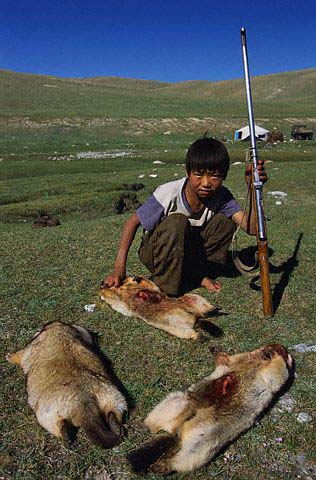
With the opening of a marmot-hunting season, Marmot Boodog becomes a very popular and fun outdoor activity for Mongolians, especially men. Marmot hunting and boodog cooking is a prerogative of men. A freshly killed marmot is separated from intestines and cleaned. Then, a prepared marmot is filled with preheated hot stones and tightly sealed. The marmot meat is cooked by the heat of stones from inside. Additional heating is provided by open fire or gas burner. The same amount of precaution as described above must be used for handling the marmot cooking process. When done, the marmot meat is very tender and tastes like wild duck according to some foreigners.
Ingredients (5 servings): 1 medium marmot Salt
Cooking gear: From small to medium sized smooth stones Firewood
Cooking time: Approximately 1.5 hours
Clean the marmot, separate the intestines and slightly remove hair from the skin. Rub the inside with salt, fill up with hot stones and seal tightly. Additionally, roast the marmot on slow open fire or with a gas burner. Usually, Mongolians do not use seasonings in order to keep the specific taste of marmot meat. When the cooking is done, the stones are pulled out, rolled in hands, the meat is cut into pieces and served hot. .
OK, so getting food advice from Penn & Teller is about like getting health care policy advice from Michael Moore ... But you know something? That turned out to be pretty good advice.
So there you go.
Which is not so say that everything you see on TV is true, even on a show called "Bullshit!"
It turns out the National Institute for Health (the authority cited), actually thinks the Atkins Diet is OK. Sure you croak early from clogged arteries, but you may die 10 pounds thinner!
Of course, I am not one to listen too carefully to NIH when it comes to diet -- they have been all over the map for five decades now and probably did thump the Atkins Diet when this video was made. When it comes to diet, maybe the NIH should just be quiet.
The bottom line, of course, is always the same in all things: live in moderation, avoid ideologues (on either side of the aisle), try to eat less and excercise more, and try to be nice to others.
Oh yes, and wash your hands and flush too. And don't litter. That is all.
Gray's Papaya at 2090 Broadway at 72nd Street has been in business selling quality hot dogs for 35 years.
No less than an authority than Anthony Bourdain says this is the place -- the #1 hot dog place in New York City hands down. And it is. For more reasons than one.
Tube meat, baby. And no, I am not afraid to see either sausage or law made.