Showing posts with label Teddy Moritz. Show all posts

Saturday, April 17, 2010

Mother Nature's Mistakes


Teddy Moritz sent me this shocking photo of a tiny 5-pound groundhog with a terrible malocclusion of the jaw which resulted in the animal's teeth growing without end. As Teddy notes in her email: "Mother Nature is not always kind."

So why was I shocked by this photo? Well, I first saw it on my cell phone, and the picture was pretty tiny. What? Is that fingernail polish? When I got back to the computer, however, I saw it was just blood. Fine; all is right with the world again. Carry on.
.

Wednesday, May 09, 2007

Working Dachshunds: Very Useful in the Field


Suli with a Spring groundhog.


Teddy Moritz writes that: "Digging season on the farms has just commenced up here. I'm starting an eighteen month old mini longhair dachshund named Suli. This is the fourth chuck she's seen in the last three days. She's making progress and the farmer is happy. Suli worked rabbits under the hawk all winter but these varmints that bite back are a different quarry."

If you have never seen a working dachshund in the field, you are missing something. They have good noses, loud voices, and chests small enough to get down the hole with ease. Another advantage they have is that they are a little less likely than a terrier to try to wrestle the quarry into submission, which means a dachshund is a little less likely than a terrier to get injured and have to sit out a week or two while things knit up. Since we can dig year round in the U.S., this is no small thing.


It should be noted that working dachshunds are not the ponderous heavy-bodied standard dachshunds most people are familiar with. In fact, to differentiate working dachshunds from their heavy-chested pet- and show-dog cousins, the German word "Teckel" is generally used.

Working Teckels come in three sizes:


  • Standard Teckels are supposed to have a chest measurement of 35 cm, or 13.78 inches. This is about the same size chest size as that of the average red fox.

  • Miniature Teckels are dogs that have a chest circumference of 30 to 35 cm measured when at least 15 months old. This smaller chest allows the dog to follow even a very small vixen to ground in a very tight earth.

  • Rabbit Teckels have a chest circumference of up to 30 cm measured when at least 15 months old. As the name suggests, these dogs are sometimes used for rabbiting, and many have chests that are as small around as 10 inches.

For those interested in working dachshunds in North America, see >> http://www.teckelclub.org/hunting-with-dachs.htm

For those interested in the German or FCI standard for the working Teckel or hunting Dachshund, see >> http://www.fci.be/uploaded_files/148GB99_en.doc (WORD document)

.

Saturday, March 24, 2007

Hazards in the Hedge


Teddy Moritz with Harris hawk, dachshund and rabbits. Teddy has worked dogs for 40 years, starting with a bull terrier and then moving to Russells before finding true happiness with working dachshunds.


The post about "glass middens" a couple of days ago got Teddy Moritz to reminiscing about some of the odd things she has dug into over the years.


"Living and mouching about for varmints in northern NJ has shown me many 'middens', aka trash heaps. One county where I lived was the bottom of an ancient lake therefore much of it is wetlands. However, before legislation to stop development many sites were filled with debris of great variety. An archeological dig in many parts of this county would probably yield trash further back than the early 1900's. Maybe Jimmy Hoffa is out there too. I did find a set of false teeth once...

"Groundhogs being the resourceful prey species they are, my dachshunds once cornered one in a damaged glass cider jug. The neck of the bottle had been broken and the chuck was harboring in the main part of the bottle. Pretty efficient for awhile. Another time a chuck was backed up under the roots of our favorite dump-site tree, a young Ailanthus. The dogs would go in, bay, then back out. I would jab my small trowel in and the chuck would bite it. I would send the dogs in and they acted as if they were blocked off. When I eventually opened the den I found an old license plate. The chuck had been pushing it up in front of the dogs when they went in. Clever rodent. The dachshunds often found chucks harboring inside old buried cars. Tough to get them out when they are in the drive shaft. One chuck was up inside a car door. When I tried to pry the door apart with my shovel the shovel handle broke, hit me on the eyebrow and knocked me out briefly. When I got the bleeding stopped I continued and we got the rascal. Half-buried old truck beds are also good places to find varmint. I once lost a red fox because he was tight up inside a bulldozed mound of old cars. Just could not get to him. Most of our groundhogs use plastic as bedding and it's not uncommon to find many yards of plastic sheeting jammed into dens. And on and on. Old farm dumps are great places to find varmints, as you've found. The broken glass can be a problem...I've got scars on my fingers where I've tried to pull dirt out and found shards of glass. The dogs often yank at old mattresses, balls of twine, old clothing, etc. when trying to get to a chuck. Good times in skanky places. Cops asked me to leave one of my best spots after it was declared a Super Fund site. There was every kind of ground game imaginable on that old landfill. Kind of spooky working a place where the ground was burning, especially in winter when the warm places were devoid of snow. The access to this spot was over an old bridge. Had to 'walk the plank' to get to the good area. The dump was an island in an old river bed, ah the memories. My big male bull terrier couldn't swim and he chased a coon into that water. About half way across the chocolate-colored water his body reminded him he had no floatation and he started to go under. I swam out to him to rescue him, grabbing sixty pounds of hard muscle and light brains. The dachshunds of course thought the bull and I had something, so they swam out too, trying to ride my shoulders. The coon got away across the river. Another swim occurred while ratting in a big landfill. The rats would run across the debris floating in the water but the dogs would have to swim. Again the bull had to be rescued. Sometimes I am amazed I had normal children, after those drenchings."

Wednesday, November 29, 2006

Whippet Good


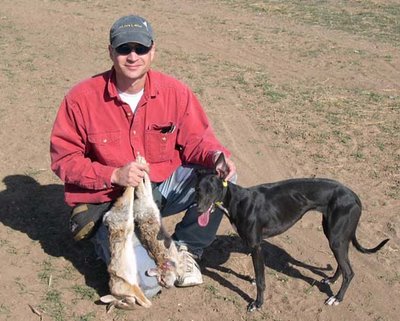
Matt Mullenix and Rina the Whippet, with Rina's first brace of rabbits. The title to this post was stolen from an email from Matt -- a reference to an old Devo song.


One of the unplanned benefits of this blog is that I have met, online, some pretty cool people who, though they may hunt differently than I do, share the same three- and four-species trials, tribulations and thrills of making it all work in the field while hunting.

Along with the folks that hunt with ferrets are the long-doggers and, perhaps most interesting of all, the hawkers and falconers. This last group is, without a doubt, the most literate group of complex-primitive hunters.

The picture, above, is of Matthew Mullenix and his young whippet Rina. There was a hawk in this hunt, of course, but as Matt explains it (quoting Gregg Barrow, another online friend), "The first season belongs to the dog," and these rabbits are purely Rina's.

The first season, of course, refers to the dog's first season -- not the hawk's or the human's. Matt's well-written and insightful journal this season is more about Rina the whippet (at least so far) than his veteran hawk Smash.

It was on Matt's blog that I learned that his old bird, Charlie, is now in stud at the Coulson's down in Louisiana (Tom and Jennifer Coulson are Harris Hawk breeders, fliers and mentors par excellence) and that Charlie had sired the new Harris Hawk that digger and hawker Teddy Moritz is now flying in New Jersey. A small universe, eh? Teddy's new hawk nailed its first bunny back in mid-October -- a development I learned on Matt's blog.

Matt took a long hawking swing around America recently. To read a little about his visit at Steve Bodio's, see the Querencia blog where he and Reid Farmer also blog with Steve.

Steve Bodio and Reid Farmer are another pair of interesting writers I stumbled upon due to this blog -- the kind of people who write about Turkish pigeons (No Dear, not Turkish prisons, Turkish pigeons), and the commonalities found among petroglyphs across the world. Three voices and three interests make for a rich gumbo at Querencia -- with occassional dashes of good stuff from other bloggers, naturalists, hawkers and doggers to spice it all up.

OK, back to dogs -- specifically hawking dogs.

I observe that a very rich and diverse variety of canines are found in the hawking world, and that the choice of dog may have less to do with the hawk than with the countryside being hawked and the collateral game than can be had in non-hawking seasons.

Teddy Mortiz, for example, hawks under a small pack of long-coated miniature dachshunds -- dogs that are useful for busting rabbits out of the tight thick stands of multiflora rose that are found in the East, but which also do double dirt dog duty on groundhog, fox, raccoon and possum.

Steven Bodio, who lives on one of the high flat stretches of upland New Mexico, has a love affair with the type of Turkish long-dog know as a Tazi -- a function of the jack rabbits, coyotes, and vast open spaces he has in his neck of the woods.

Hawker Rebecca O'Connor recently acquired a nice red Brittany. Her first Brittany was so well acclimated it licked the Falcon on the face and the bird actually tolerated it. A small all-pupose bird dog, Brittany's do well in a wide variety of cover -- a good all-rounder for California.

In other parts of the country, Jack Russells and beagles are popular for busting bunnies out of brush, while down in Louisiana, Matt has a fondness for whippets which are good warm-weather dogs for swamp rabbits and cotton rats as well as for busting birds out of tall tropical grasses.

For more on the subject, see >> Rabbit Hawker's Dogs.


A young male Harris Hawk and a longhaired dachshund named Fitz (as in Fitz-in-dens) which has an 11 inch inch chest, both owned and hunted by Teddy Moritz. The young tiercel Harris has been doing the business on eastern cotton tails.

Wednesday, October 06, 2004

A Hawking & Dirt Dog Combination


Teddy Moritz with miniture dachshund, Harris Hawk and seven nice cotton tales -- a good day in the field!

The miniature dachshund is an undervalued dog in the field, where its keen nose, small size, booming voice and ability to stay out of serious trouble make it invaluable when hunting week in and week out.
Lancaster News, Lancaster, Pennsylvania, February 17, 2002
Miniature hounds do a big job in the field

By: John McGonigle

__________________

Teddy Moritz of Rockaway, N.J., is a real piece of work. I mean hard-core. And I mean it in the best possible way.

No Janie come lately, Moritz has been involved with falconry since 1966.

Married, with grown children, Moritz quit her various naturalist and Fish and Wildlife agency positions because work was interfering with her hunting.

"My husband is a saint," Moritz said of her active hunting schedule.

As if hawks are not enough work, Moritz became involved with miniature longhair dachshunds in 1976.

"Only the hunting kind," Moritz said quickly. "All my dogs have Field Champion titles and American Working Terrier Association Natural Hunting certificates."

While it is evident that her dog's titles and certificates are important, Moritz said pointedly, "The dogs have to satisfy my criteria."

Which, by watching the way her dogs work, appear high.

Moritz is also an American Kennel Club judge for field trials and earth-dog trials. Earth dogs are terriers and other dogs bred to enter underground dens, or burrows, to oust concealed wildlife.

Moritz's hunting clothes reveal a lot about her. The colors are muted, well worn and
tough.

She is soft-spoken in the field, as hunters should be. She has no false modesty and speaks highly of her dogs while they ably demonstrate the good qualities she conveys. Moritz is resolute and confident as she follows her small hounds with her Harris hawk. The day's events affirm her confidence.

The miniature longhair dachshunds Moritz breeds, trains and hunts are genuine, realistic hunting dogs. Though I generally have no use for very small dogs, these 7-to-10-pounders opened my eyes. I would guess their legs at six inches, maximum, but they move them, and keep moving them. They have a lot of heart.

Don't misunderstand me; these miniatures are not fast. But they are fast enough to push a rabbit from the brush, keep on its tail and keep it moving. That is all that is needed for either falconry or regular rabbit hunting.

While following Moritz's miniature hounds (remember, they weigh 7-10 pounds each) near an apartment complex, we rounded a corner of a woodlot and saw three boys, probably about fourth graders, running for their collective lives with about five miniature longhair dachshunds chasing them.
Moritz called her dogs and they broke off the chase, not that their little legs could ever catch the youngsters. It was the funniest thing I have ever seen while hunting.

The youngsters approached us, cautiously at first, to see the small dogs and found them not only harmless, but also lovable. We added three more (little) brush beaters to the group.

Moritz's hounds were black and tan, colored and marked very similarly to a Gordon setter. The dogs are cute little things and are definitely functional hunters.

Teddy Moritz and her miniature hounds added a great deal to our falconry experience. They made an already great day better.